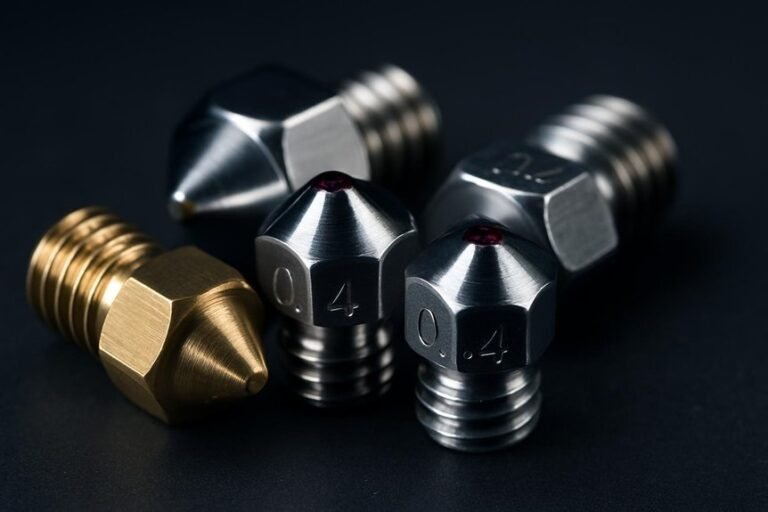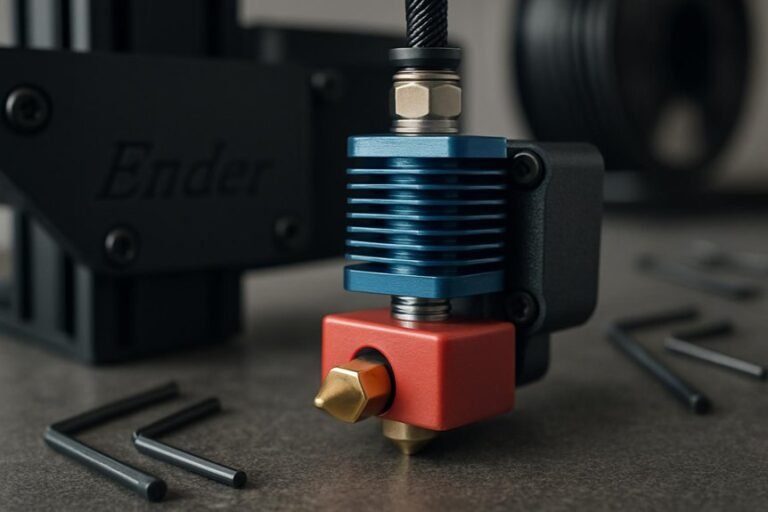
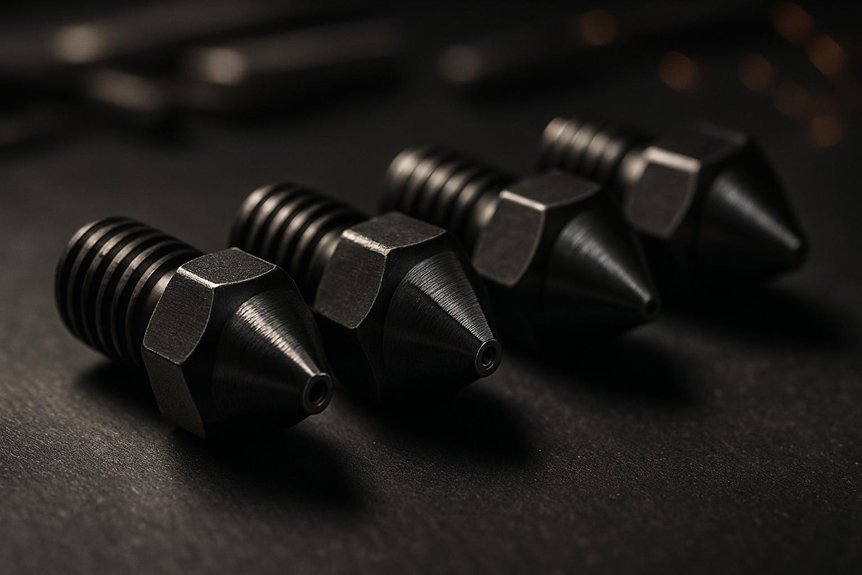
If you print with abrasive filaments, you need nozzles that won’t wear out after a few hours, and hardened steel is the smart choice. You’ll find budget 5-packs, upgrade kits for Bambu Lab and V6 hotends, and versatile MK8 sets that fit different needs and budgets. I’ll compare durability, fit, and flow so you can pick the right nozzle for your printer — and avoid costly downtime.
Mudder Hardened Steel 0.4mm Nozzles for 1.75mm 3D Printers (5-Pack)
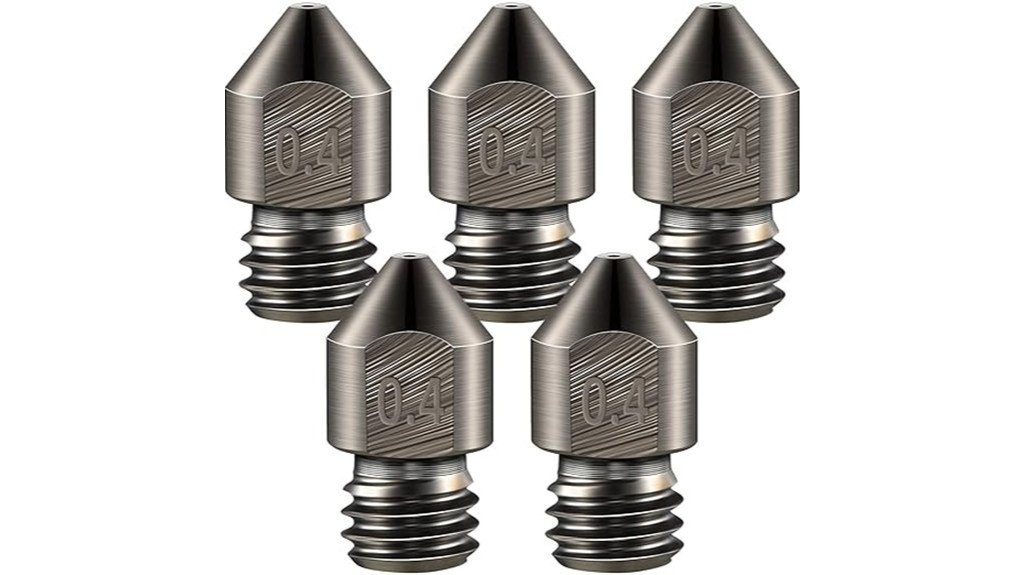
If you print with abrasive filaments like carbon-fiber or fiberglass blends, the Mudder hardened steel 0.4 mm nozzles are a smart, budget-friendly choice—especially if you run a Creality or MK8-style hotend. You’ll get five hardened tool steel nozzles made for 1.75 mm filament, and they fit many printers like Ender and Prusa models. They resist wear, heat, and corrosion, so they last longer with abrasive materials. Users note accurate extrusion thanks to tight diameter tolerances, though clogs can happen depending on filament. You should adjust temps, keep extras handy, and expect solid performance for the price.
Best For: Makers and hobbyist 3D printers who frequently use abrasive filaments (carbon- or glass-filled) and need durable, MK8-compatible nozzles for 1.75 mm filament.
Pros:
- Hardened tool steel construction resists wear from abrasive filaments, extending nozzle life.
- Comes in a 5-pack, offering spare nozzles at a budget-friendly price.
- Tight diameter tolerance (<0.02 mm) and smooth inner walls help maintain consistent extrusion.
Cons:
- Hardened steel has lower thermal conductivity than brass, which can require higher print temperatures or tuning.
- Some users report occasional clogs depending on filament quality and settings.
- Mixed quality-control reports; tip sizes and fit may vary, so compatibility with tools or exact dimensions isn’t guaranteed.
Hardened Steel Nozzle Kit for Bambu Lab X1/X1 Carbon and P1P/S Hotend (0.2–1.0mm, 1.75mm, Includes Tools)
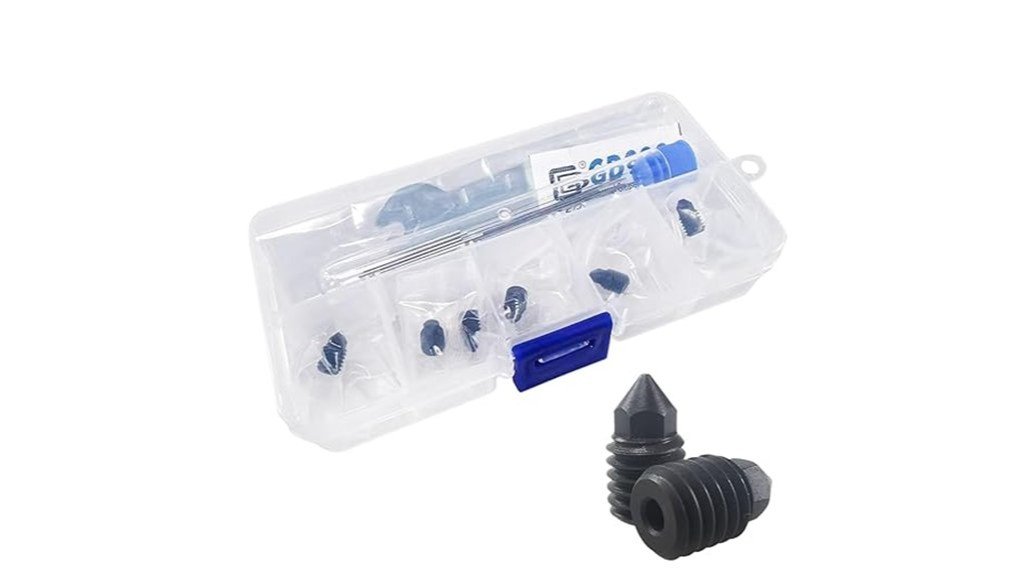
You’ll appreciate this hardened steel nozzle kit if you regularly print with abrasive filaments or want parts that last longer than brass, especially on Bambu Lab X1/X1 Carbon and P1P/S machines. The kit fits upgraded hotends (not original) and includes 0.2, two 0.4, 0.6, 0.8, and 1.0mm nozzles, ten needles, a parts box, wrench, and thermal paste. Made from hardened tool steel, they resist wear, heat, and corrosion, and the smooth, burr-free bore improves flow. Marked sizes and standard M6 threads make swaps quick. Note: 0.2mm can clog with large carbon fillers; tighten when hot.
Best For: Makers and professionals who print abrasive or high-temperature filaments on Bambu Lab X1/X1 Carbon or P1P/S upgraded hotends and need longer-lasting, wear-resistant nozzles.
Pros:
- Hardened tool steel construction offers superior wear, heat, and corrosion resistance compared to brass, extending nozzle life with abrasive filaments.
- Kit includes multiple nozzle sizes (0.2, 0.4×2, 0.6, 0.8, 1.0 mm), cleaning needles, wrench, parts box, and thermal paste for convenient swaps and maintenance.
- Smooth, burr-free bore and clearly marked sizes with standard M6 thread simplify installation and improve filament flow.
Cons:
- Not compatible with original (non-upgraded) Bambu Lab hotend kits—only fits upgraded hotends.
- 0.2 mm nozzle is prone to clogging with carbon-fiber or large-particle filled filaments.
- Hardened steel has lower thermal conductivity than brass, which can affect print thermal behavior and require small tuning adjustments.
4pcs Hardened Steel V6 0.4mm Nozzles for V6 Hotend 3D Printers (Prusa, Anycubic)
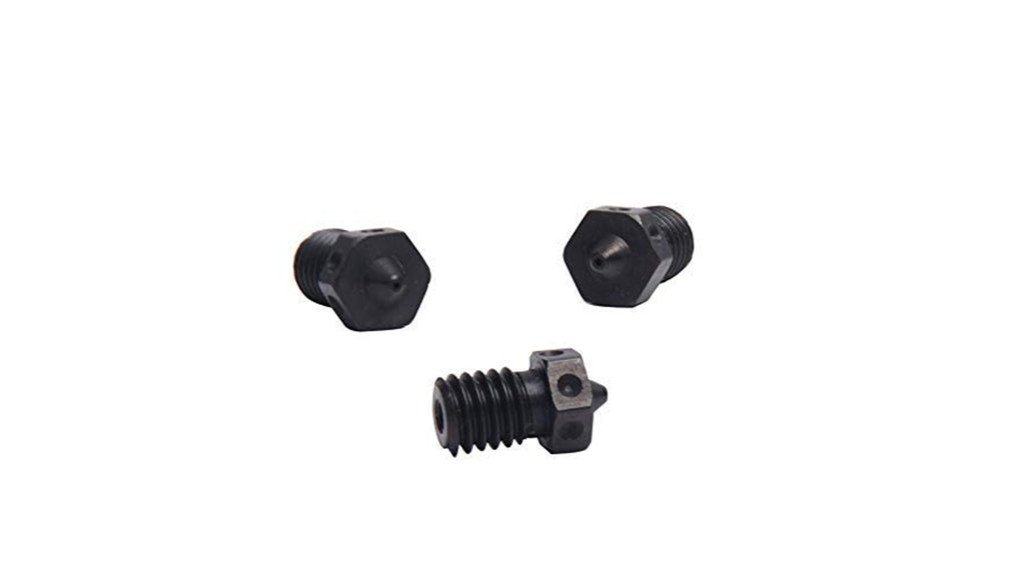
For makers who print a lot with abrasive filaments like carbon fiber PLA, nylon blends, or filled ASA, these 4pcs hardened steel V6 nozzles are a smart upgrade because they resist wear far better than brass and keep your prints sharp over many runs. You’ll get four CNC-machined 0.4mm nozzles for 1.75mm filament with M6 threads, marked by dot codes for quick ID, and they fit V6 hotends on Prusa, Anycubic, Flsun, and some Voron setups. Installation’s straightforward though you may tweak Z-offset, and users praise longevity and improved surface finish despite occasional rust or clog reports.
Best For: Makers and small-scale pro users who frequently print with abrasive filaments (carbon fiber PLA, nylon blends, filled ASA) and need durable, long-lasting V6-compatible 0.4mm nozzles.
Pros:
- CNC-machined hardened steel resists wear from abrasive filaments and maintains nozzle shape much longer than brass.
- Comes as a 4-pack of M6-threaded 0.4mm nozzles (1.75mm filament) with dot size markings for easy identification.
- Broad compatibility with V6 hotends (Prusa i3 MK3/MK3S, Prusa Mini, Anycubic, Flsun, some Voron/Dragonfly setups) and generally easy to install.
Cons:
- Hardened steel has lower thermal conductivity than brass, which can affect heat transfer and may require print parameter tweaks.
- Some users report occasional clogging or corrosion/rust issues over time.
- A few buyers received defective or incomplete sets and some adjustments to Z-offset may be needed due to different nozzle length.
Creality Hardened Steel MK8 Nozzles Kit for 3D Printers (Multiple Sizes)
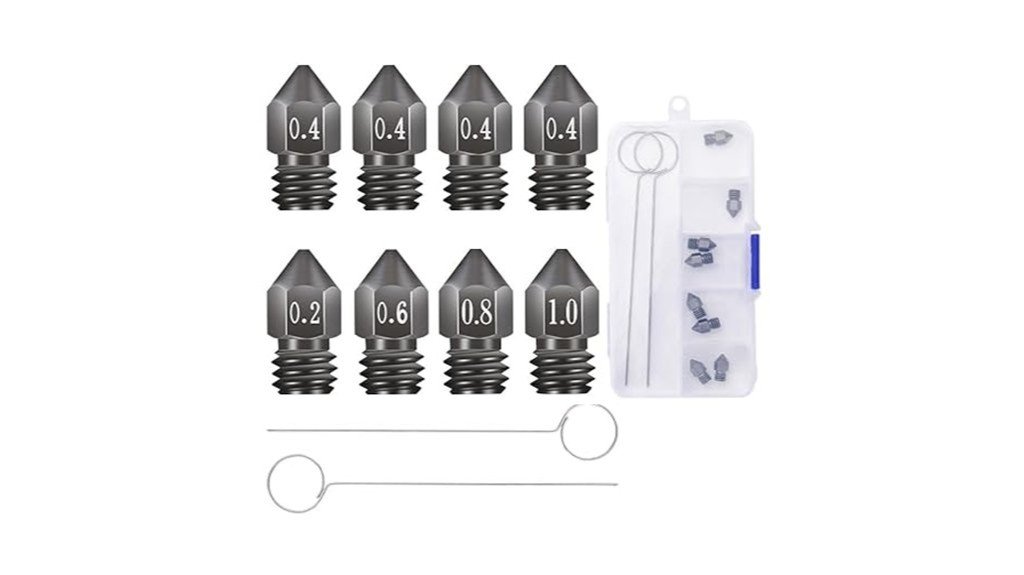
Makers who regularly print with abrasive filaments will like the Creality Hardened Steel MK8 nozzle kit because it pairs long-lasting toughness with a convenient range of sizes—0.2mm through 1.0mm—so you can switch between fine detail and fast infill without wearing out a brass tip. You get eight hardened tungsten steel nozzles with HRC60+ hardness, a compact tool box, and two needle cleaners for quick unclogs. They handle up to 450°C, so PLA, ABS, carbon-fiber blends, and even PEEK work fine. CNC-made for concentricity and smooth interiors, they fit most MK8-style printers like Ender and CR-10 models.
Best For: Makers who frequently print abrasive or high-temperature filaments and want a durable, ready-to-use set of MK8 nozzles in multiple sizes for both fine detail and fast infill.
Pros:
- Hardened tungsten steel (HRC60+) greatly reduces wear from abrasive filaments like carbon-fiber blends.
- Includes a range of nozzle sizes (0.2–1.0 mm), a tool storage box, and two needle cleaners for convenience and versatility.
- Rated to 450°C and CNC-machined for concentricity and smooth interiors, improving reliability and compatibility with many MK8 printers.
Cons:
- Hardened steel transfers heat differently and can produce less thermal conductivity than brass, potentially affecting extrusion tuning and print surface finish.
- Slightly more difficult to thread or remove if overtightened; requires care and appropriate tools when changing.
- May be overkill for users who only print non-abrasive PLA at low temperatures and prefer the finer detail/brass offers.
Factors to Consider When Choosing Hardened Steel Nozzles for Abrasive Filament
When you’re picking a hardened steel nozzle for abrasive filament, you’ll want to check the material hardness rating so it can resist wear and last longer. Also look at available orifice sizes, heat tolerance limits, and a clear filament compatibility list to make sure the nozzle matches the filaments and printing temps you use. Finally, pay attention to installation and fit so the nozzle threads and heat block align properly and you don’t end up wrestling with a part that won’t seat.
Material Hardness Rating
Although it might seem like a small spec on a product page, the Rockwell hardness rating tells you a lot about how a hardened steel nozzle will hold up to abrasive filaments. You’ll see hardened steel nozzles typically above HRC60, and that matters: higher hardness means better resistance to wear from carbon fiber or nylon composites, so the nozzle lasts much longer than brass. When the steel keeps its shape, you get fewer clogs and steadier performance over time. Precision CNC machining also helps by producing smooth inner walls without burrs, which keeps filament flowing consistently. If you print often with abrasive materials, choosing the right hardness rating saves you replacement headaches and downtime.
Orifice Size Options
Orifice size matters a lot when you’re picking a hardened steel nozzle for abrasive filament, because it affects detail, flow, and how often you’ll need to clear clogs. You’ll find sizes from about 0.2mm up to 1.0mm, so pick based on the look and speed you want. A 0.2mm orifice gives finer detail but can clog more easily with gritty filaments, which taught me to clean more often when I chased tiny layers. Bigger openings like 0.8–1.0mm handle coarse, viscous blends and let you print faster with fewer blockages. Also match the nozzle to your filament diameter—most printers use 1.75mm—to avoid extrusion problems. Balance detail, clog risk, and print speed to choose the right size for your project.
Heat Tolerance Limits
Because hardened steel nozzles can handle much higher temperatures than brass, you’ll get steadier performance with heat-hungry or abrasive filaments and less risk of warping or rapid wear. Hardened steel typically tolerates up to about 450°C, so it keeps its shape and precision during long, hot prints. That means you can run higher-temperature materials without the nozzle softening or degrading like brass might. When you choose a nozzle, match its heat limits to the filament’s recommended extrusion temperature — that simple step prevents clogging, under-extrusion, and ruined parts. I once swapped in a hardened steel tip for a tough, gritty filament and watched print quality hold steady over many hours. In short, pick a nozzle rated above your filament’s peak processing temperature.
Filament Compatibility List
Now that you know hardened steel holds up to higher temperatures, let’s look at which filaments pair best with those nozzles and what to watch for when you pick one. You’ll find hardened steel ideal for abrasive blends like carbon-fiber, fiberglass, and many nylons because they wear brass quickly. Check the nozzle’s inner wall — it should be smooth and burr-free to reduce clogs and keep extrusion consistent. Match the nozzle to the filament: some work better with ABS, PETG, or flexible TPU, while others are meant for high-temp materials like PEEK. Remember nozzle diameter: tiny openings (0.2 mm) can clog if the filament has large filler particles. With regular maintenance and proper care, your hardened steel nozzle will last much longer.
Installation and Fit
1 key thing to check before you swap in a hardened steel nozzle is that it actually fits your hotend — threading, length, and profile all matter. You’ll want to confirm your printer uses the same thread (most MK8/V6 nozzles use M6), since mismatched threads mean no-go. Heat the hotend before loosening or tightening to prevent oozing and get a clean seat. Note that hardened steel nozzles can sit a bit shorter than brass ones, so you’ll likely need to tweak your Z-offset and run a test print. After installation, tighten securely but don’t overtighten, and inspect for gaps that cause leaks or clogs. Regular checks keep prints reliable and save you headaches down the road.
FAQ
Are Hardened Steel Nozzles Compatible With All Hotend Types?
1. Are hardened steel nozzles universally compatible with all hotends?
Mostly, yes. However, compatibility can depend on specific design features of the hotend.
2. What factors should I check for compatibility?
You should verify the fit and thermal properties of the nozzle with your hotend model.
3. Can hardened steel nozzles fit sealed hotends?
Not necessarily. Some sealed designs may restrict the installation of hardened steel nozzles due to their specific configurations.
4. Are there any issues with ceramic-insulated hotends?
Yes, ceramic-insulated hotends may not accommodate hardened steel nozzles due to their unique insulation methods.
5. Do thread sizes affect nozzle compatibility?
Absolutely. Different thread sizes can prevent a proper fit of hardened steel nozzles in certain hotends.
6. How does heat transfer influence nozzle compatibility?
Differences in heat transfer properties between hotends can impact how well a hardened steel nozzle performs.
7. Can I use a hardened steel nozzle with my standard hotend?
In most cases, yes. Just ensure that your standard hotend meets the necessary specifications for the nozzle.
8. What should I do if my hotend is incompatible?
Consider upgrading to a compatible hotend or using a different type of nozzle that fits your current setup.
9. Are there specific hotends known for compatibility with hardened steel nozzles?
Many popular models are designed to work well with hardened steel nozzles, but always check the manufacturer’s recommendations.
10. Is installation of hardened steel nozzles complicated?
Installation is generally straightforward if compatibility is confirmed; just follow standard procedures for nozzle replacement.
Do Hardened Steel Nozzles Affect Print Quality Vs Brass?
FAQ 1: Do hardened steel nozzles affect print quality?
Yes, hardened steel nozzles can slightly affect print quality by reducing thermal transfer, which may lead to less crisp fine details compared to brass nozzles.
FAQ 2: How does extrusion response differ between hardened steel and brass nozzles?
Hardened steel nozzles may exhibit slower extrusion response due to their thermal properties, which can impact the precision of filament delivery during printing.
FAQ 3: Are there any trade-offs when using hardened steel nozzles?
Using hardened steel nozzles offers increased durability for abrasive filaments, but you may sacrifice some surface fidelity and detail in your prints.
FAQ 4: How do hardened steel nozzles perform with fine details?
Hardened steel nozzles may not produce fine details as crisply as brass nozzles because of their thermal characteristics, which can affect the overall print quality.
FAQ 5: What happens to print quality with abrasive filaments?
While abrasive filaments are better suited for hardened steel nozzles, the trade-off is a potential decrease in surface fidelity compared to using brass nozzles.
FAQ 6: Is durability a significant advantage of hardened steel nozzles?
Yes, hardened steel nozzles are much more durable and can withstand the wear and tear from abrasive filaments better than brass nozzles.
FAQ 7: Can I use hardened steel nozzles for all types of filaments?
While you can use hardened steel nozzles for various filaments, they are particularly recommended for abrasive materials due to their durability.
FAQ 8: How quickly do hardened steel nozzles blunt compared to brass?
Hardened steel nozzles tend to blunt faster than brass nozzles, which can impact the consistency of your prints over time.
FAQ 9: Are there specific applications where brass nozzles are preferred?
Brass nozzles are often preferred for applications requiring high detail and precision due to their superior thermal transfer and ability to produce finer surface finishes.
FAQ 10: Should I choose hardened steel nozzles for general printing?
If you primarily print with standard filaments and require high detail, brass nozzles may be a better choice. However, for frequent use with abrasive materials, hardened steel nozzles are ideal.
How Do I Prevent Clogging With Abrasive Filaments?
FAQ 1: What type of nozzle should I use for abrasive filaments?
Use hardened nozzles specifically designed to withstand the wear caused by abrasive materials. This will help prevent premature nozzle damage and maintain print quality.
FAQ 2: How does printing speed affect clogging with abrasive filaments?
Printing slower can reduce the likelihood of clogs as it allows for better layer adhesion and reduces stress on the nozzle. Always ensure your printing speed is within the filament’s specifications.
FAQ 3: What temperature settings should I use for abrasive filaments?
Printing hotter can help improve flow and reduce the risk of clogs. Make sure to stay within the recommended temperature range for the specific filament you are using.
FAQ 4: Is a larger nozzle diameter beneficial for abrasive filaments?
Yes, using a slightly larger nozzle diameter can help reduce clogging by allowing more material to flow through. This can be particularly helpful when printing with highly abrasive materials.
FAQ 5: How can I minimize retraction to prevent clogs?
Keep retraction settings minimal by adjusting the retraction distance and speed in your slicer. This helps reduce the chances of filament jamming or buildup in the nozzle.
FAQ 6: Why is consistent filament drying important?
Consistent filament drying helps remove moisture that can cause printing issues and clogs. Properly dried filament flows better and reduces the chances of unwanted bubbling during printing.
FAQ 7: What are cold pulls and how do they help with clogs?
Cold pulls, also known as atomic pulls, involve heating the nozzle, then cooling it down while pulling the filament out. This process helps to clear any buildup inside the nozzle, preventing future clogs.
FAQ 8: How often should I perform cold pulls?
It is recommended to perform cold pulls regularly, especially after printing with abrasive filaments or if you notice any signs of clogging. Regular maintenance can help ensure optimal nozzle performance.
FAQ 9: Can using abrasive filaments damage my printer?
Yes, if not managed properly, abrasive filaments can wear down standard nozzles and other components. Using the right materials and techniques can help mitigate this risk.
FAQ 10: What should I monitor during prints with abrasive filaments?
Monitor for any signs of under-extrusion or inconsistent flow, as these can indicate potential clogs. Keeping an eye on print quality can help you address issues before they escalate.
Can Hardened Steel Nozzles Be Coated or Plated?
1. Can hardened steel nozzles be coated or plated?
Yes, hardened steel nozzles can be coated or plated.
2. What types of coatings are suitable for hardened steel nozzles?
Common coatings include nickel, chrome, and diamond-like carbon (DLC).
3. What benefits do coatings provide for hardened steel nozzles?
Coatings enhance wear resistance and reduce friction, improving nozzle longevity and performance.
4. Is professional application necessary for coating hardened steel nozzles?
Yes, professional application is recommended to ensure proper adhesion and effectiveness of the coating.
5. Will the adhesion of the coating be consistent over time?
Adhesion can vary, and it may not always be consistent, leading to potential issues over time.
6. How often should coated nozzles be recoated?
Recoating may be necessary occasionally to maintain long-term durability, depending on usage.
7. Are there any specific considerations for coating thickness?
The thickness of the coating can affect performance, so it should be tailored to the nozzle’s application.
8. Can coatings affect the nozzle’s compatibility with different materials?
Yes, coatings can impact compatibility with certain materials, so testing may be required.
9. Will coatings alter the nozzle’s original dimensions?
Coating can add a layer to the nozzle, potentially altering its original dimensions, which should be accounted for in design.
10. Are there any risks associated with coating hardened steel nozzles?
Potential risks include inconsistent adhesion and possible performance issues if the coating fails, necessitating careful selection and application.
Are There Specific Slicer Settings for Abrasive Materials?
1. What print speed should I use for abrasive materials?
For abrasive filaments, it’s recommended to use a slower print speed to minimize wear on the nozzle and ensure better layer adhesion.
2. Should I adjust the nozzle temperature for abrasive filaments?
Yes, you should set a slightly higher nozzle temperature when printing with abrasive materials to enhance flow and prevent clogging.
3. How can I reduce retraction settings for abrasive materials?
Lowering retraction settings helps to minimize backpressure and reduces the risk of clogging, which is particularly important for abrasive filaments.
4. What is the recommended flow margin for printing with abrasive filaments?
Increasing the flow margin can help ensure that enough material is extruded, compensating for any wear that may occur in the nozzle.
5. Is it advisable to use a thicker first layer with abrasive filaments?
Yes, using a thicker first layer can improve bed adhesion and help prevent issues caused by uneven first-layer extrusion.
6. What cooling settings should I use for abrasive materials?
It’s advisable to use slower cooling settings to allow for better layer bonding and to prevent potential warping during the print process.
7. How does the extrusion path affect printing with abrasive materials?
A longer extrusion path can help to reduce backpressure in the nozzle, which is crucial for maintaining consistent flow and preventing wear on the nozzle tip.
8. What type of nozzle is best for abrasive filaments?
Using a hardened steel or ruby-tipped nozzle is recommended for abrasive materials, as they are more resistant to wear compared to standard brass nozzles.
9. Should I calibrate my printer differently for abrasive filaments?
Yes, it may be beneficial to recalibrate your printer settings, including flow rate and temperature, specifically for abrasive filaments to achieve optimal results.
10. Can I use standard slicer profiles for abrasive materials?
Standard slicer profiles may not yield the best results for abrasive materials; it’s important to customize settings to accommodate their unique characteristics.
Final Thoughts
When it comes to printing with abrasive filaments, you need to make informed choices about your nozzles. I recommend the Mudder 0.4mm pack if you’re looking for reliable, budget-friendly replacements. For those who demand top-tier wear resistance and a variety of sizes, the Bambu Lab kit is the way to go. If you’re using V6 hotends, the V6 Hardened Steel nozzles are your best bet. And if versatility is what you need, the Creality MK8 kit offers multiple sizes that will serve you well. Always keep in mind the nozzle size, compatibility, and durability to ensure you achieve consistent, high-quality results. Trust me, these factors matter.