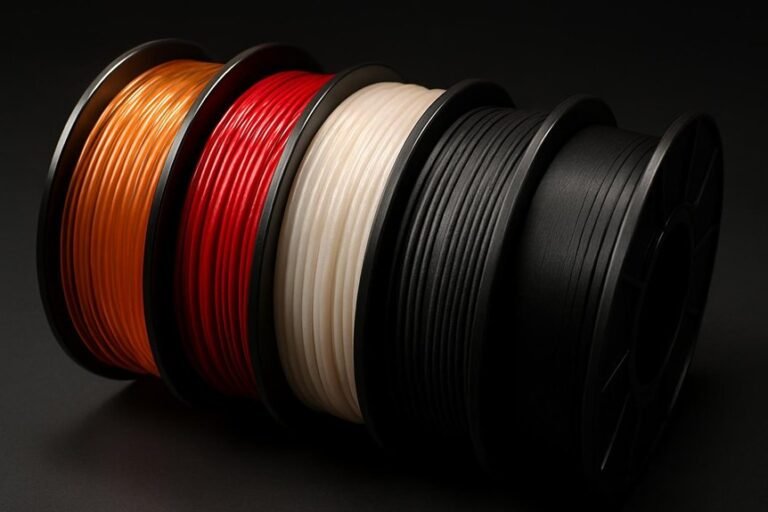
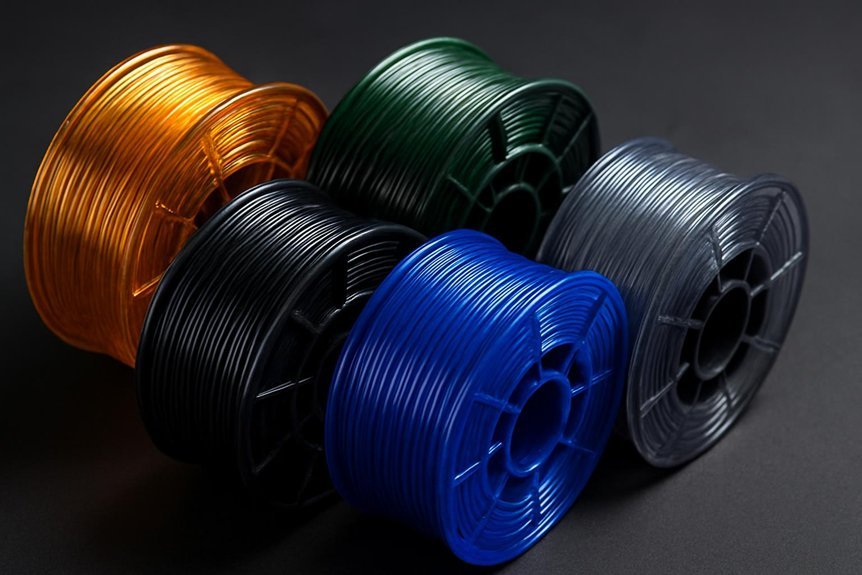
If you print functional parts, PETG is a smart choice for strength, impact resistance, and steady dims, and I’ll walk you through five top filaments that balance durability and printability. You’ll learn which spools give reliable layer adhesion, low stringing, and consistent feed—plus a few tips for tuning temps and speeds so your parts fit and last. Keep going and you’ll know which PETG suits your project and printer.
TECBEARS PETG 1.75mm 4-Color 4x1kg Filament Bundle (White, Blue, Red, Black)
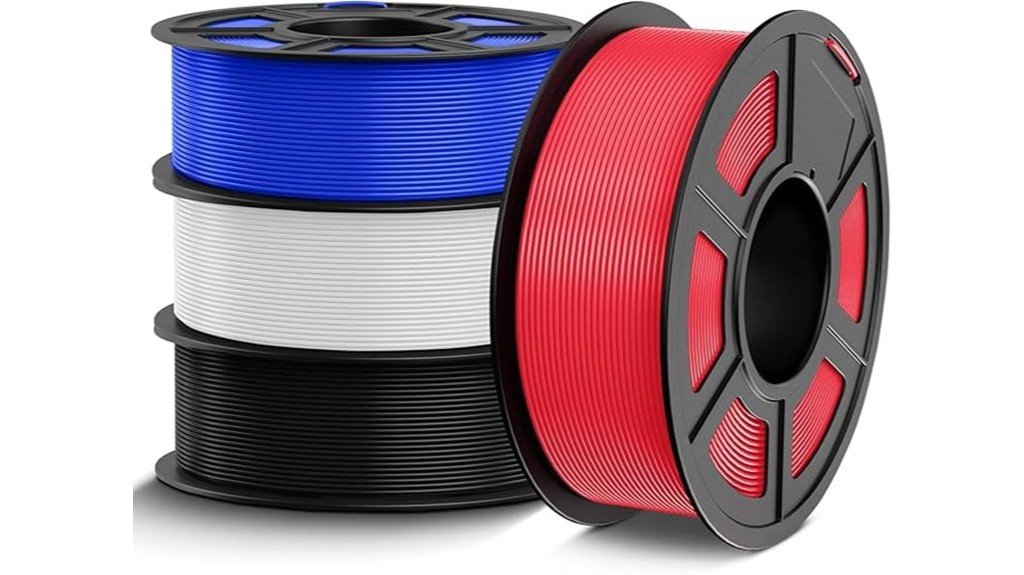
If you’re looking for a reliable all-around PETG that works for hobbyists and small shops alike, the TECBEARS 1.75mm 4-color bundle is a solid pick — think of it as a versatile starter pack for anyone who prints a lot and needs dependable results. You get four 1kg spools in white, blue, red, and black, offering bright, vibrant options for projects. The PETG mixes PLA’s ease and ABS’s toughness, so your parts resist impact, acids, and weather while staying dimensionally stable. It prints glossy, clear, and translucent finishes, and the manufacturing reduces tangles and clogs, boosting your success rate.
Best For: Hobbyists and small shops who need a versatile, reliable PETG starter bundle with bright colors and consistent print performance.
Pros:
- Combines PLA ease and ABS toughness for durable, weather- and chemical-resistant parts.
- Four 1kg spools (white, blue, red, black) provide vibrant color options for varied projects.
- Manufactured to reduce tangles, twisting, and clogging, improving print success rates.
Cons:
- PETG can be more stringy than PLA and may require tuned retraction settings.
- Limited to four colors in this bundle, which may not suit projects needing a wider palette.
- May require a heated bed and enclosure for optimal adhesion on some printers.
OVERTURE PETG 1.75mm 1kg (2.2lbs) 3D Printer Filament (Black)
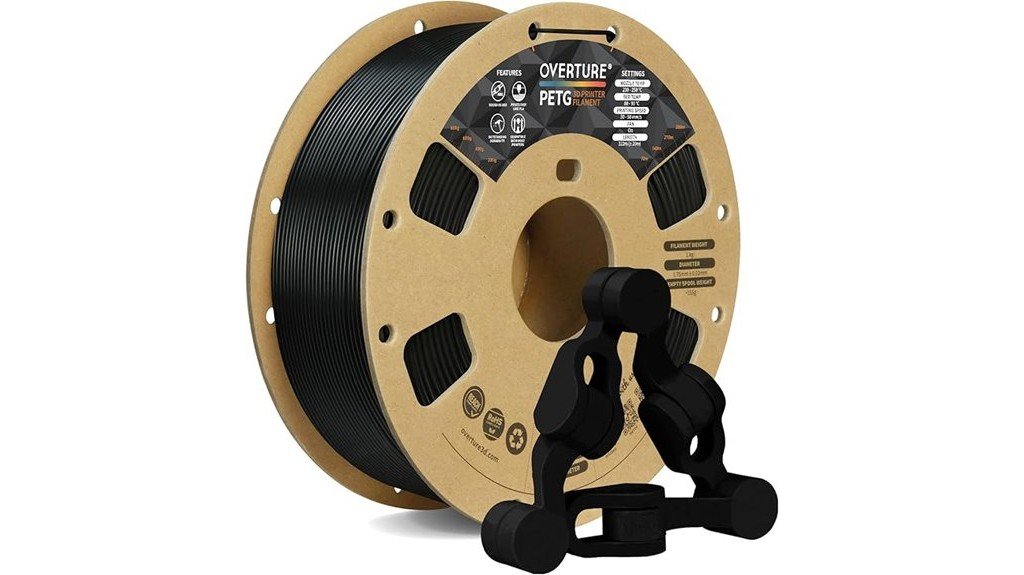
For hobbyists and small workshops who want a reliable, tough filament without fuss, the OVERTURE PETG 1.75mm (1kg) in Black stands out for its blend of strength and ease of use. You’ll get a precise +/-0.02mm diameter on a tangle-free, precision-wound spool that prints strong, low-shrinkage parts with excellent layer adhesion. Run it at 245–255°C with a 70–85°C bed and moderate speeds around 38mm/s for best results; faster can cause stringing. It’s tougher than PLA, simpler than ABS, and comes vacuum-sealed with a resealable bag—dry it if it sat a while.
Best For: Hobbyists and small workshops seeking a reliable, tough filament that balances strength, ease of printing, and minimal fuss.
Pros:
- Strong, durable prints with excellent layer adhesion and low shrinkage—good for functional parts and outdoor use.
- Precision-wound, consistent 1.75mm (+/-0.02mm) spool that reduces tangles and extrusion issues.
- Vacuum-sealed packaging with a resealable bag; prints well at recommended settings (245–255°C nozzle, 70–85°C bed).
Cons:
- PETG can string if printed too fast or without optimized retraction; recommended speeds are moderate (~38mm/s).
- May require drying if the spool has absorbed moisture or sat unused, adding an extra step.
- Slightly more difficult to print than PLA (higher temperatures) and may stick to the nozzle or bed if cooling/adhesion settings aren’t tuned.
Creality PETG 3D Printer Filament 1.75mm 1KG (Black)

Creality’s PETG 1.75mm (1KG) in black is a great pick if you want a step up from PLA without the headaches of ABS — it’s tough, glossy, and prints reliably for makers who need functional parts. You’ll like its 1.75mm ±0.03mm precision and smooth feeding, which help avoid clogs and ugly first layers. It prints at 220–250°C with a 70–80°C bed, bonds well between layers, and resists cracking and warping. The spool arrives vacuum-sealed with a desiccant, neatly wound to prevent tangles. Overall, it’s user-friendly, budget-smart, and solid for mechanical or outdoor prints.
Best For: Makers and hobbyists who want a durable, easy-to-print upgrade from PLA for functional or outdoor parts without the hassles of ABS.
Pros:
- Consistent 1.75mm ±0.03mm diameter and smooth feeding reduce clogs and ensure reliable first layers.
- Tough, glossy prints with excellent layer adhesion and minimal warping—good for mechanical and outdoor-use parts.
- Vacuum-sealed packaging with desiccant and tangle-free winding prevents moisture and feeding issues out of the box.
Cons:
- Requires higher nozzle and bed temperatures (220–250°C / 70–80°C) compared with PLA, so not ideal for printers without heated beds or capable hotends.
- PETG can be more prone to stringing than PLA unless temperature and retraction are dialed in.
- Less rigid than some engineering filaments (e.g., ABS or nylon), so not suitable for parts needing very high heat resistance or stiffness.
SUNLU PETG 1.75mm High Speed 3D Printer Filament, 1kg Spool (Black)
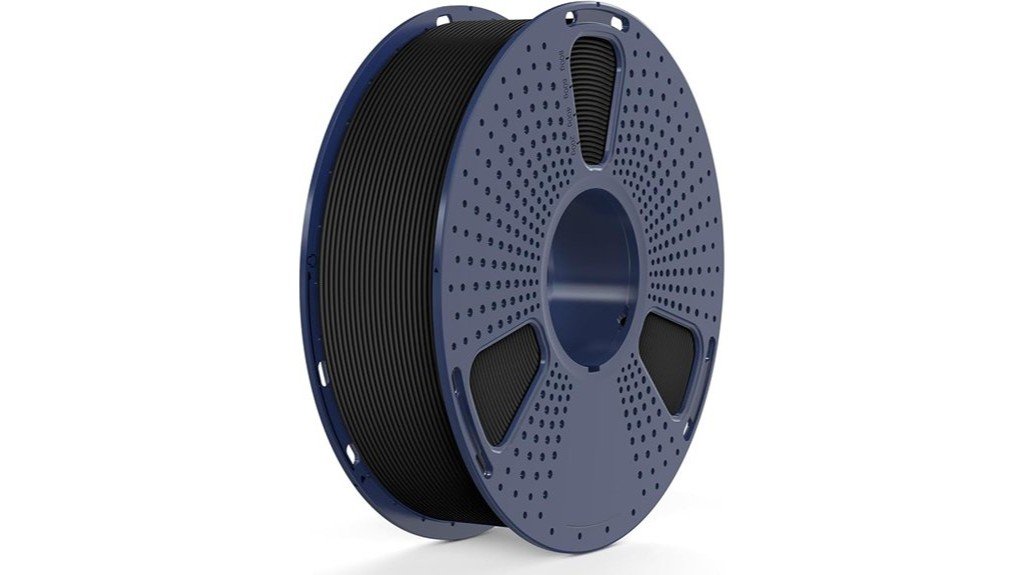
The SUNLU High Speed PETG is a great pick if you want a reliable, fast-printing filament that works with most FDM printers, including Bambu Labs machines. You’ll like its wide speed range — it prints cleanly from 30mm/s up to 600mm/s when you tune temps: 230–240°C for 50–100mm/s, 240–255°C for 100–300mm/s, and 255–270°C for the fastest settings. It blends PLA ease with ABS-like toughness, resists moisture and chemicals, and holds up to about 80°C. Reviews praise consistent prints and low stringing, though some colors vary. Dry spools before printing, and use the 30-day return if needed.
Best For: Makers and hobbyists who want a fast, durable PETG filament that prints cleanly across a wide speed range and works with most FDM printers, including Bambu Labs.
Pros:
- Consistent print quality with good layer adhesion and minimal stringing.
- Very wide recommended speed range (30–600 mm/s) for both standard and high-speed printing.
- Tough, moisture- and chemical-resistant parts that withstand up to ~80°C.
Cons:
- Color consistency can vary between spools, especially for certain colors (white, red).
- Some users report issues with specific spools and recommend drying filament before use.
- High-temperature settings for extreme speeds may require careful tuning and printer capability.
SUNLU PETG 1.75mm 2kg (Black) 3D Printer Filament Bundle
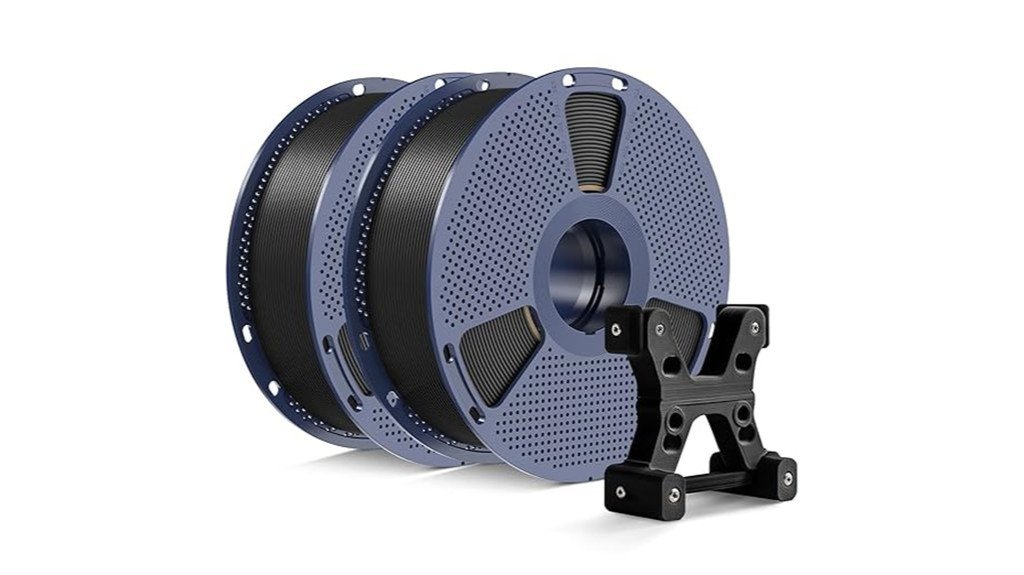
If you want a durable PETG that’s also easy to use, SUNLU’s 1.75mm 2kg black bundle is a smart pick for hobbyists and small shops who print a lot and want consistent results. You’ll like that it blends ABS-like strength with PLA-style ease, delivering glossy, impact-resistant parts. The reusable spool and precise 1.75 ±0.02mm diameter cut down jams and waste, and it feeds cleanly into Bambulab and MarsWork machines. Print at 220–250°C with a 65–75°C bed, and dry the filament first for best adhesion. It’s affordable, reliable, and a solid bulk option despite occasional stock hiccups.
Best For: Hobbyists and small print shops that need affordable, durable PETG filament for frequent, reliable prints.
Pros:
- Durable, impact-resistant prints with glossy finish and strong layer adhesion.
- Reusable, tangle-free spool and precise 1.75 ±0.02mm diameter reduce jams and waste.
- Compatible with Bambulab and MarsWork printers and offers excellent value for bulk use.
Cons:
- Recommended to dry before use, adding an extra preparation step.
- Occasional reports of filament breaks and spool material shortages.
- Some stock availability issues for the bulk pack.
Factors to Consider When Choosing PETG Filament for Functional Parts
When you’re making functional parts, you’ll want PETG that balances strength and toughness so pieces don’t snap under stress, while still holding tight tolerances for accurate fits. Think about temperature and chemical resistance if parts will face heat or solvents, and pick a filament that prints reliably and handles moisture well so you don’t fight warping or brittle prints. I’ll walk you through what to look for in specs and real-world printing tips so you can choose the best PETG for the job.
Mechanical Strength and Toughness
1 clear reason many makers pick PETG for functional parts is its combination of strength and toughness: you’ll get high impact resistance that beats PLA, plus excellent layer adhesion so parts hold together under stress. When you need a part that won’t crack or shatter, PETG’s toughness gives you confidence—I’ve printed clips and brackets that survived drops and daily use without splitting. Its resistance to environmental stress means housings, handles, and mechanical linkages keep working even when bumped or flexed. You’ll also appreciate PETG’s ability to tolerate temperatures up to about 80°C, so parts used near warm electronics still perform. Together, these traits make PETG a reliable choice for durable, functional prints where failure isn’t an option.
Dimensional Accuracy and Tolerance
You’ve seen how PETG’s toughness keeps parts from cracking, and now let’s look at another thing that makes those parts reliable: dimensional accuracy and tolerance. When filament diameter matches its spec—usually within +/- 0.02mm to +/- 0.03mm—you’ll get steady extrusion and fewer surprises. That consistency prevents under- or over-extrusion, which otherwise ruins layer lines and weakens parts. Precise tolerances also improve layer adhesion, so printed pieces hold up under load instead of delaminating. If diameter wanders, you risk clogging, uneven bonding, or outright print failures, and that’s frustrating when you need a working part. Choose PETG from manufacturers with strict quality control and you’ll see better mechanical performance, predictable prints, and fewer failed jobs to waste time and material.
Temperature and Chemical Resistance
Even though PETG looks simple to print, its temperature and chemical resistance are what really make it a go-to for functional parts, so you’ll want to pay attention to those traits before choosing a spool. PETG holds strength up to about 80°C without warping, so parts near engines, electronics, or warm sunlit spots stay true to shape. Its impact resistance and low shrinkage help keep dimensions steady, which you’ll notice when gears or brackets keep fitting over time. PETG also resists moisture and many chemicals, so outdoor or workshop parts won’t degrade quickly. Look for filaments advertised with high layer adhesion, since good bonding prevents layer separation under stress. That combination of heat tolerance, chemical durability, and strong layers makes PETG reliable for real-world use.
Printability and Ease
Knowing PETG’s heat and chemical toughness tells you what parts will hold up, but printability and ease determine how reliably you’ll actually make those parts. You want filament that bonds well between layers and shows minimal stringing, so your prints come out strong and tidy without endless cleanup. Check recommended print speeds — some PETG can run up to 600mm/s, which saves time if your printer and design can handle it. Consistent diameter (around 1.75mm ±0.02mm) prevents under- or over-extrusion, giving steadier results. Prefer precision-wound, tangle-free spools to avoid jams that ruin long prints. Finally, choose filaments that arrive vacuum-sealed and moisture-resistant so you reduce the odds of surprise failures mid-print.
Moisture Management and Storage
Because PETG soaks up moisture from the air, storing and drying it correctly makes a big difference in how your prints turn out. Keep unopened spools in vacuum-sealed bags or resealable containers with desiccant packs to block humidity; that simple step prevents the bubbling, poor layer adhesion, and weakened parts that wet filament causes. If a spool spent time in a humid room, dry it before printing — many users warm spools in a filament dryer or a low-temperature oven to restore performance. Unopened PETG lasts about a year when stored well, but moisture shortens that, so check spools regularly for brittleness or odd popping sounds while printing. Catching moisture issues early saves time and helps you produce reliable functional parts.
Surface Finish and Aesthetics
Once you’ve got moisture under control and your PETG spool is behaving, you’ll notice the material’s look becomes one of its biggest strengths. You’ll get high transparency and gloss that give functional parts a professional, almost polished appearance. Light passes through PETG well, so colors pop and tiny details stay clear — great when visual quality matters. Low shrinkage means dimensions hold up, so surfaces stay consistent without ugly warping. PETG’s toughness also protects the finish from scratches and impacts during use, so parts keep looking good over time. In short, if you want durable parts that also look attractive, PETG hits a sweet spot. Just dial in print settings and your results will shine.
FAQ
Can PETG Be Safely Used for Food-Contact or Medical Applications?
FAQ 1: Can PETG be used for food-contact applications?
Yes, PETG can be used for food-contact applications if the filament is certified food-safe. Proper printing practices and post-processing are essential to ensure safety.
FAQ 2: Is PETG suitable for medical applications?
PETG can be used for medical applications if it meets specific certifications and standards for safety. It’s crucial to validate the sterilization process for medical items.
FAQ 3: What certifications should PETG have for food safety?
The PETG filament should be certified by relevant food safety standards to ensure it is safe for contact with food. Always check for certifications before use.
FAQ 4: What kind of nozzle should be used when printing with PETG for food or medical items?
When printing PETG for food or medical applications, it’s recommended to use appropriate stainless steel nozzles. This helps prevent contamination during the printing process.
FAQ 5: How important is post-processing for PETG items intended for food or medical use?
Post-processing is critical for ensuring the sanitary quality of PETG prints. Proper cleaning and finishing techniques should be employed to minimize contamination risks.
FAQ 6: Does sterilization affect PETG printed items?
Yes, sterilization is necessary for PETG items intended for medical use. It is essential to validate the sterilization method to ensure it does not compromise the material’s integrity.
FAQ 7: Are all PETG filaments safe for food contact?
No, not all PETG filaments are safe for food contact. Always verify that the specific filament used is certified for food safety.
FAQ 8: What precautions should be taken during the printing process of PETG for food or medical use?
In addition to using certified materials, ensure a clean printing environment and avoid using contaminated equipment. This helps maintain the safety of the final product.
FAQ 9: Can I assume PETG is safe for food or medical use if it looks clean?
No, visual cleanliness does not guarantee safety. Always check for proper certifications and follow recommended practices for food or medical applications.
FAQ 10: What should I do if I’m unsure about the safety of PETG for my application?
If unsure, consult with the filament manufacturer for certifications and safety guidelines. It’s better to err on the side of caution when it comes to food and medical safety.
How Does PETG Compare to Nylon for Chemical Resistance?
FAQ 1: How does PETG compare to nylon in terms of chemical resistance?
PETG is generally less chemically resistant than nylon. While PETG can withstand many acids and alcohols, nylon offers superior resistance to solvents, fuels, and stronger chemicals.
FAQ 2: What types of chemicals can PETG resist?
PETG can resist several acids and alcohols, making it suitable for applications with milder chemical exposure. However, its resistance is limited compared to nylon.
FAQ 3: When should I choose nylon over PETG for chemical applications?
Nylon is the better choice for applications involving harsh chemical exposure, due to its higher tolerance for solvents and stronger chemicals. If the environment includes aggressive chemicals, nylon should be preferred.
FAQ 4: Is PETG suitable for all chemical environments?
No, PETG is not suitable for all chemical environments. It works best in milder conditions and may degrade or fail in more aggressive chemical settings.
FAQ 5: Can PETG be used in food applications?
Yes, PETG is often used in food applications due to its resistance to moisture and certain chemicals. However, ensure it complies with food safety regulations.
FAQ 6: In what situations is nylon favored?
Nylon is favored in situations where there is a risk of exposure to solvents, fuels, or harsh chemicals. Its robust chemical resistance makes it ideal for industrial applications.
FAQ 7: Are there any chemicals that PETG cannot tolerate?
Yes, PETG can be degraded by certain strong solvents and chemicals, which can lead to failure in those applications. It’s crucial to assess the specific chemical exposure before choosing PETG.
FAQ 8: How does environmental temperature affect the chemical resistance of PETG and nylon?
Environmental temperature can affect the performance of both materials. Generally, higher temperatures can decrease chemical resistance, particularly for PETG.
FAQ 9: What are the implications of using PETG in aggressive chemical environments?
Using PETG in aggressive chemical environments can lead to material degradation, compromising structural integrity. It’s essential to evaluate the chemical exposure before using PETG.
FAQ 10: Can nylon be used in applications with mild chemicals?
Yes, nylon can be used in applications with mild chemicals, but it may be considered over-engineering in such cases. PETG may be a more economical choice for less demanding environments.
FAQ 11: How do the costs of PETG and nylon compare for chemical resistance applications?
Generally, nylon is more expensive than PETG due to its superior chemical resistance. However, the choice between them should consider not just cost but also the specific requirements of the application.
Can I Dye or Paint PETG Parts After Printing?
1. Can I dye PETG parts after printing?
Yes, PETG parts can be dyed after printing. It’s essential to clean them thoroughly before applying any dye.
2. What preparation is needed before dyeing PETG?
Before dyeing, clean the PETG parts and lightly sand them to enhance dye adhesion. This helps achieve a more even color finish.
3. Are there specific dyes recommended for PETG?
Use solvent-free dyes that are compatible with plastic to avoid damaging the material. Look for dyes specifically designed for synthetic materials.
4. Is it necessary to apply a primer before painting PETG?
Yes, applying a compatible primer or adhesion promoter is recommended before painting PETG. This improves paint adhesion and durability.
5. What type of paint is suitable for PETG?
Choose flexible paints that are solvent-free to prevent warping or cracking. This ensures the paint remains intact over time.
6. Can I use regular spray paint on PETG?
Regular spray paint may not adhere well to PETG and could lead to issues like peeling. It’s better to use paints specifically formulated for plastics.
7. Will dyeing or painting affect the strength of PETG parts?
If done correctly, dyeing or painting should not significantly affect the strength of PETG parts. However, improper application can lead to weaknesses.
8. How can I ensure an even dye finish on PETG?
Ensure the parts are clean and evenly sanded before dyeing. Apply dye in thin, even layers to achieve a consistent color.
9. Is it safe to use heat when dyeing PETG?
Using heat can help with dye absorption, but be cautious not to exceed PETG’s temperature tolerance. Follow specific dyeing instructions for best results.
10. What is the best way to maintain dyed or painted PETG parts?
To maintain the appearance of dyed or painted PETG, avoid harsh chemicals and clean gently with mild soap and water. Regular care helps preserve the finish.
Does PETG Require Post-Annealing for Dimensional Stability?
1. Does PETG need post-annealing for dimensional stability?
No, PETG typically does not require post-annealing for dimensional stability as most parts are stable directly after printing.
2. What are the benefits of annealing PETG?
Annealing can relieve internal stresses in the material and improve its heat resistance, making it beneficial for applications requiring higher thermal performance.
3. When should I consider annealing PETG?
Consider annealing PETG if you need tighter tolerances or enhanced dimensional accuracy for your specific application.
4. How does annealing affect the properties of PETG?
Annealing can enhance the thermal stability of PETG, allowing it to withstand higher temperatures without deforming.
5. Is post-annealing necessary for all PETG prints?
No, post-annealing is not necessary for all PETG prints; most will maintain their shape and properties without it.
6. Can I print PETG without worrying about warping?
Yes, PETG is generally less prone to warping compared to other materials like ABS, making it a reliable choice for many prints.
7. What are the signs that my PETG print might need annealing?
If you notice warping, dimensional inconsistencies, or if the print will be subjected to high temperatures, annealing may be beneficial.
8. Does the printing process affect the need for annealing?
Yes, factors such as print speed, layer height, and cooling settings can influence whether your PETG print might require annealing.
9. How do I anneal PETG correctly?
To anneal PETG, heat it in an oven at a controlled temperature, typically around 70-80°C, for a recommended duration, ensuring even heating.
10. Are there any downsides to annealing PETG?
While annealing can improve certain properties, it may also lead to slight changes in color or surface finish, which should be taken into account for aesthetic applications.
What Storage Method Best Prevents PETG Moisture Absorption?
FAQs on Storing PETG to Prevent Moisture Absorption
1. What is the best way to store PETG filament?
Store PETG filament in airtight containers or vacuum-sealed bags to minimize moisture exposure.
2. Should I use desiccants when storing PETG?
Yes, including desiccants in your storage containers helps absorb any residual moisture, further protecting the filament.
3. Where is the ideal location to store PETG spools?
Keep PETG spools in a dry, cool environment to prevent moisture absorption and maintain the filament’s integrity.
4. Why is moisture a concern for PETG?
Moisture can lead to brittleness in PETG filament and affect the dimensional stability, which can result in poor print quality.
5. How do airtight containers help with PETG storage?
Airtight containers prevent moisture from entering, ensuring that the filament remains dry and usable for longer periods.
6. Can vacuum bags be used for storing PETG?
Yes, vacuum bags are an effective way to eliminate air and moisture, providing a protective environment for your PETG spools.
7. What happens if PETG absorbs moisture?
If PETG absorbs moisture, it can lead to printing issues such as stringing, bubbling, and poor layer adhesion.
8. Is it necessary to check the condition of stored PETG regularly?
Yes, periodically checking the condition of your stored PETG can help you catch any moisture issues before they affect your prints.
9. Can I use silica gel as a desiccant for PETG storage?
Silica gel is an excellent choice for a desiccant, as it effectively absorbs moisture and can be reused after drying.
10. Should I keep the original packaging for PETG?
It’s advisable to keep the original packaging, as it can provide an extra layer of protection against moisture when stored properly.
Final Thoughts
When it comes to selecting the best PETG filaments for functional parts, you need options that deliver on strength, stability, and ease of printing. I’ve tested these filaments extensively, and I can tell you that each one brings something valuable to the table. TECBEARS offers a vibrant color range perfect for prototyping, while OVERTURE and Creality are your go-to for producing consistent, robust parts that won’t let you down. If you’re tackling faster or heavier printing jobs, SUNLU’s offerings are designed to handle the workload effectively.
To achieve the best results, ensure you have good bed adhesion, maintain the appropriate printing temperatures, and set moderate retraction settings to minimize stringing. With some fine-tuning, these filaments will enable you to create functional, durable prints that you can confidently put to use. Choose wisely, and you won’t be disappointed.