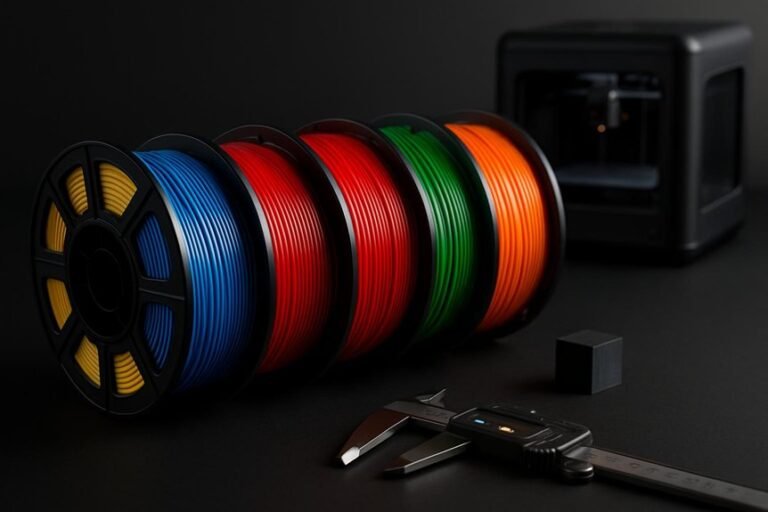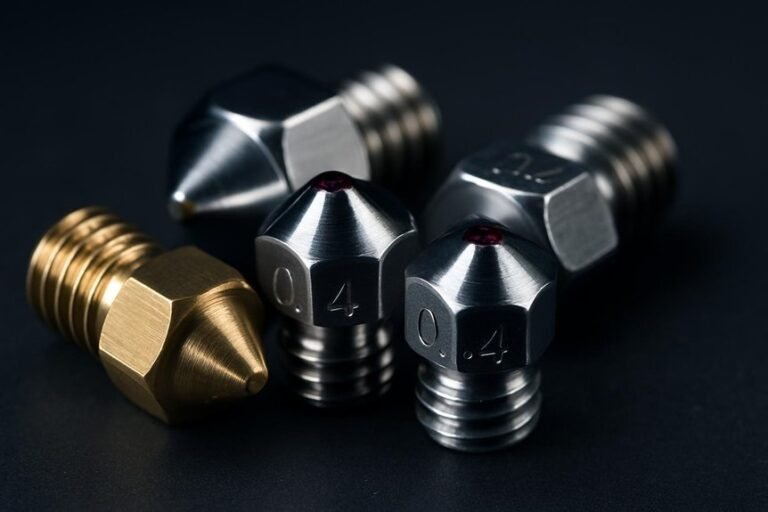
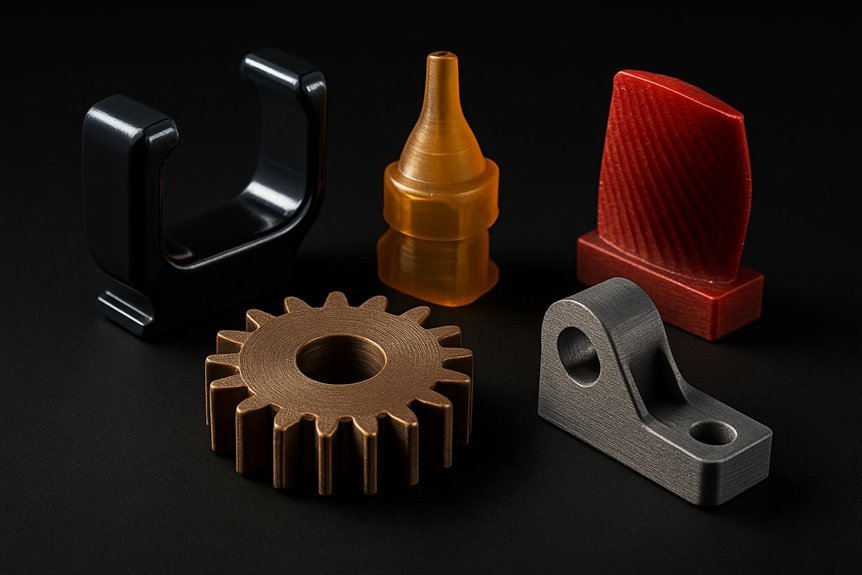
If you need parts that survive heat, sun, and rough use, these five filaments are where to start: ASA variants for weather resistance and toughness, a glass-filled HT‑PLA for tight tolerance and low warping, and a PPA for high mechanical strength and thermal aging resistance. I’ll walk you through what makes each one stand out, how they print, and when to pick each — plus a few tips to avoid warping and weak layers so your parts actually last.
Polymaker ASA 1.75mm 1kg Black 3D Printing Filament
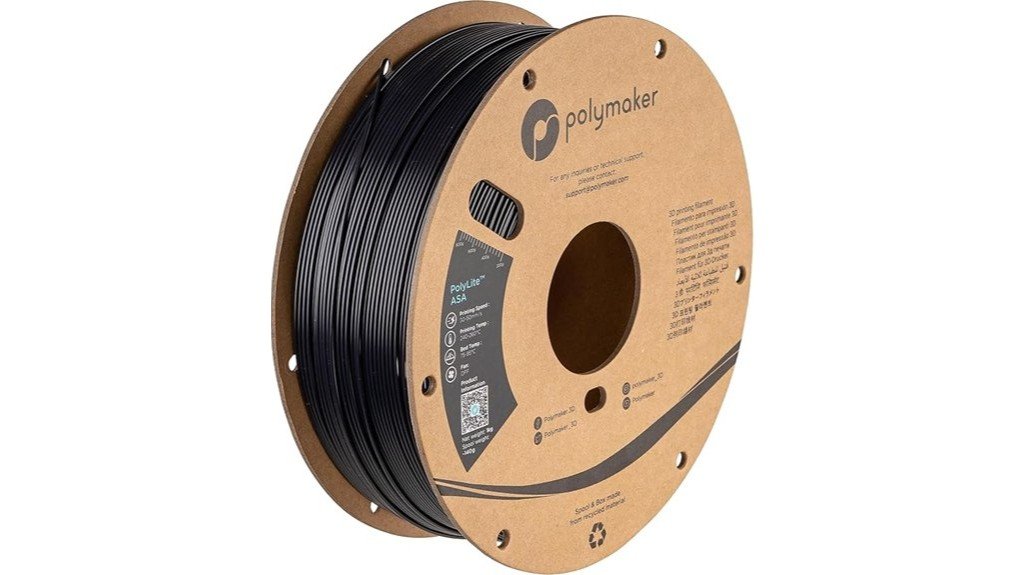
If you need a filament that can take the heat—literally—Polymaker ASA 1.75mm (1kg, Black) is a smart pick for makers who print outdoor or functional parts, like RC planes or car accessories. You’ll appreciate its ABS-like strength plus added UV and weather resistance, so parts don’t fade or crack when left outside. It handles heat up to about 100°C and absorbs impacts well, which matters for moving parts. Print with a 250°C nozzle and 90°C bed, around 50mm/s, and use an enclosure for big pieces to prevent warping. Packaging is recycled, and lifetime support gives you confidence.
Best For: Makers and hobbyists who need heat- and weather-resistant filament for outdoor or functional parts (e.g., RC planes, car accessories) and who can print in an enclosed, higher-temperature setup.
Pros:
- Excellent UV and weather resistance, reducing fading and environmental stress cracking for outdoor use.
- High heat tolerance (~100°C) and good impact toughness, suitable for functional parts.
- Recycled packaging and lifetime technical support provide environmental and post-sale benefits.
Cons:
- Requires high printing temperatures (250°C nozzle, 90°C bed) and an enclosure for large prints, which not all printers support.
- More prone to warping like ABS, necessitating careful setup and possible print tuning.
- Typically pricier and less beginner-friendly than PLA alternatives.
TINMORRY ASA 1.75mm 3D Printer Filament (1KG Spool, Black)
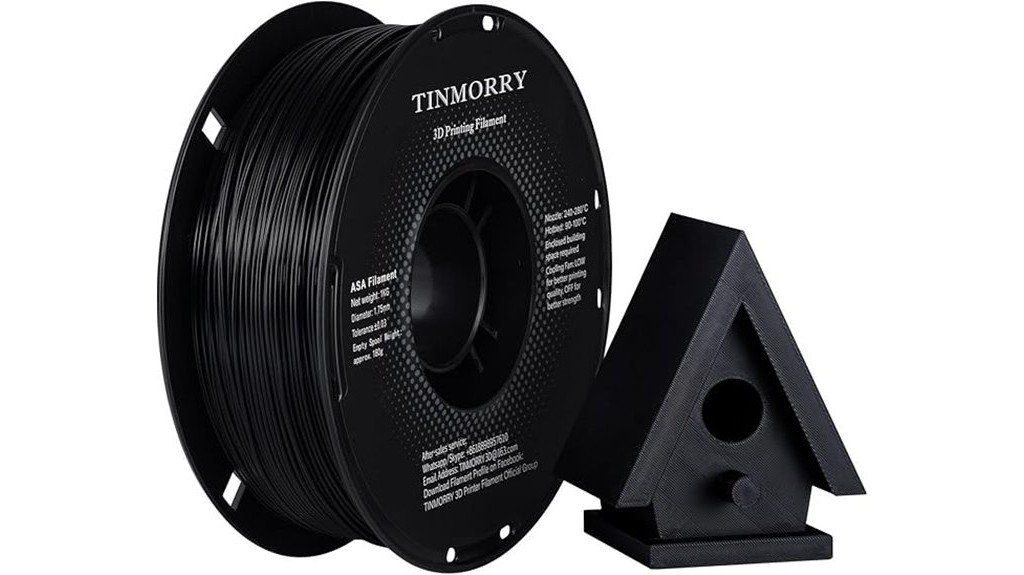
For makers who need outdoor-ready parts that still print cleanly, TINMORRY’s ASA filament is a smart pick—it’s built to resist UV and weathering so your prints won’t fade or become brittle after months in the sun. You get a 1kg spool of 1.75mm black ASA with +/-0.03mm accuracy, rated to about 100°C and offering high toughness and impact resistance. Print at 240–280°C with a 90–100°C bed, keep speeds moderate, and use an enclosure for best results. Users praise adhesion, low stringing, and consistent finishes; hardened nozzles help with abrasive blends. It’s a reliable outdoor workhorse.
Best For: Makers and professionals who need durable, weather-resistant outdoor parts that still print with good surface finish and dimensional accuracy.
Pros:
- Excellent UV and weather resistance with high toughness and ~100°C heat resistance, ideal for outdoor use.
- Good printability with strong adhesion, minimal stringing, and +/-0.03mm dimensional accuracy.
- Compatible with common 1.75mm setups and popular printers (e.g., Bambu X1C/P1S); 1kg spool size is convenient.
Cons:
- Requires an enclosure and relatively high print/bed temperatures (240–280°C / 90–100°C).
- May be abrasive if blended (users recommend hardened nozzles and gears), increasing wear on standard hardware.
- Not as easy as PLA for beginners; higher-temperature settings and enclosure add complexity.
SUNLU ASA 1.75mm UV/Rain/Heat Resistant 3D Printer Filament (1kg), Black
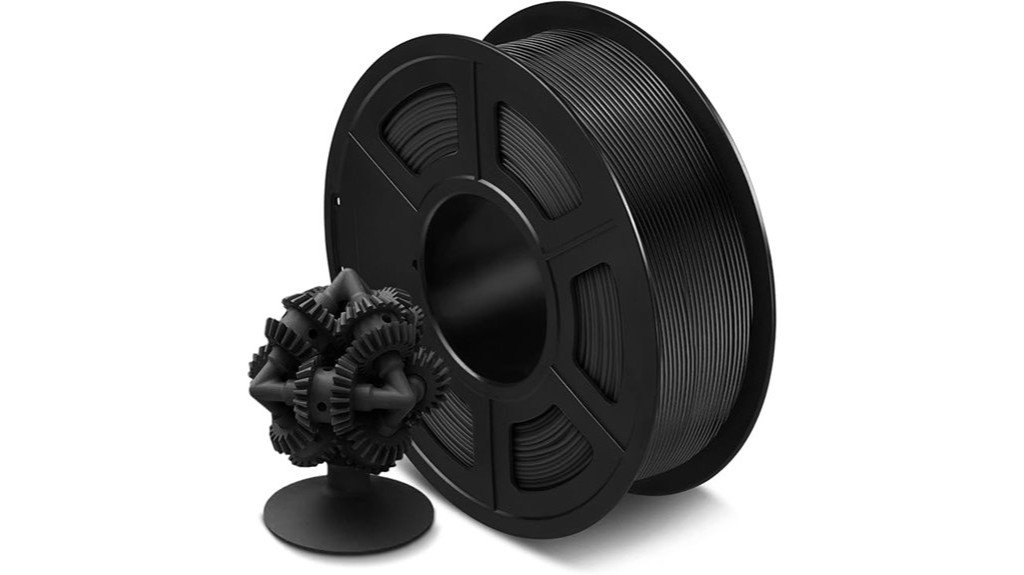
SUNLU’s ASA filament is a solid pick if you need tough, weatherproof parts that’ll stand up to sun, rain, and heat—think outdoor housings, brackets, or functional prototypes that can’t afford to fail. You’ll like its strength and toughness compared with PLA or ABS, plus reliable layer adhesion and few clogs or bubbles. Print at 230–260°C with a bed at 80–120°C, and use speeds around 50–100mm/s. The 1kg black spool is accurate to ±0.02mm and fits most 1.75mm FDM printers; the new high-temp spool helps drying. Use an enclosure and adhesives for best results.
Best For: Outdoor makers and engineers needing durable, UV/rain/heat-resistant 3D printed parts like housings, brackets, and functional prototypes that must withstand weather and mechanical stress.
Pros:
- Excellent toughness and weather resistance compared with PLA/ABS, making it ideal for outdoor use.
- Good dimensional accuracy (±0.02mm) and reliable extrusion with few clogs or bubbles.
- High-temperature spool design for improved drying and compatibility with most 1.75mm FDM printers.
Cons:
- Can be prone to bed adhesion and warping; may require adhesives, tape, or an enclosure.
- Requires high nozzle and bed temperatures (230–260°C / 80–120°C), which not all printers can safely reach.
- Stronger odors during printing and sensitivity to temperature fluctuations can necessitate an enclosure and ventilation.
Polymaker HT-PLA-GF 1.75mm Grey High-Temp 3D Printer Filament (1kg)
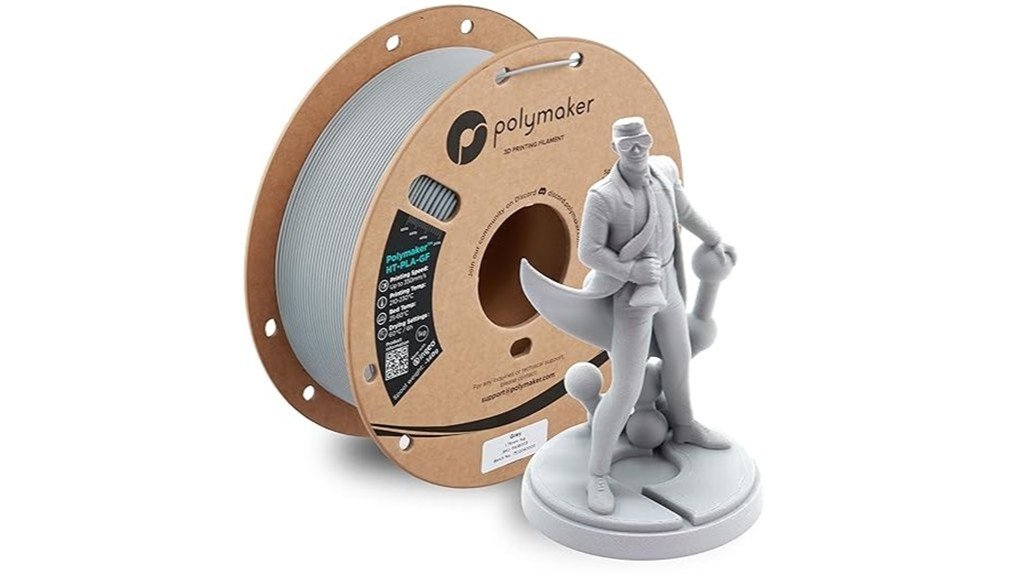
Polymaker’s HT-PLA-GF is a great pick if you need PLA-level ease with near-engineering heat resistance — it’s built to survive sustained temperatures up to about 150°C, so you can confidently print parts that live in hot garages, car interiors, or sun-baked enclosures. You’ll find it prints like PLA—easy, fast, and compatible with most FDM machines—yet it’s stiffer and holds shape under heat. Layer adhesion is excellent, warping is minimal, and the satin textured finish looks professional. Annealing boosts performance for demanding uses. Users praise consistency and strength, though some report spool damage in shipping. Ideal for jigs, fixtures, and automotive bits.
Best For: Engineers, hobbyists, and print farms needing PLA-like ease with high heat resistance for functional parts like jigs, fixtures, and automotive components.
Pros:
- Prints easily like PLA with smooth extrusion, high dimensional accuracy, and support for fast print speeds.
- Heat resistant up to ~150°C and maintains shape in hot environments; annealing can further improve performance.
- Excellent layer adhesion, minimal warping, and a professional satin textured finish suitable for functional and aesthetic parts.
Cons:
- Stiffer than standard PLA and may be brittle for applications needing flexibility.
- Some users report spool damage during shipping; preference for sturdier plastic reels.
- While easier than engineering plastics, it still may not match the chemical or impact resistance of higher-end materials.
Siraya Tech Fibreheart PPA 3D Printing Filament (1kg, 1.75mm)
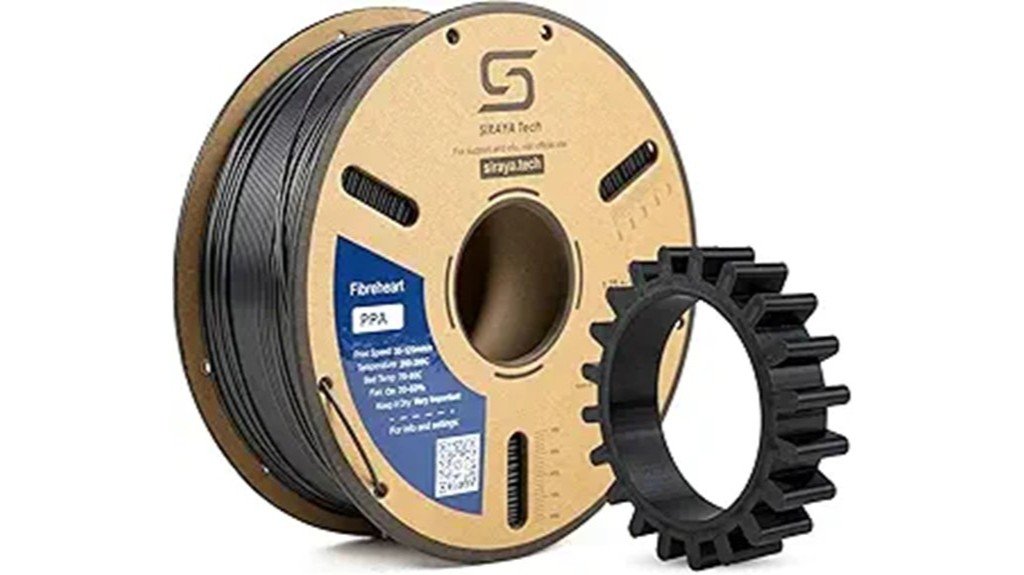
If you need a filament that handles heat, chemicals, and heavy wear, Siraya Tech’s Fibreheart PPA is a top pick for engineers and hobbyists who print functional parts. You’ll get a high-performance polyphthalamide nylon in 1.75mm, 1kg spools that’s dense and stiff—70 MPa tensile and 114 MPa flexural strength when dry. It resists moisture much better than PA6, tolerates harsh chemicals, and holds up in hot environments like automotive or aerospace. Print at 260–300°C with a 70–110°C bed and expect low friction for gears and bearings, though you may tweak settings to prevent shrinkage or brittleness.
Best For: Engineers and advanced hobbyists who need a heat-, chemical-, and wear-resistant nylon filament for high-strength functional parts, gears, and automotive/aerospace prototypes.
Pros:
- High mechanical strength and stiffness (70 MPa tensile, 114 MPa flexural when dry) for durable end-use parts.
- Superior moisture and chemical resistance compared with PA6, suitable for harsh environments.
- Low friction and self-lubricating properties make it ideal for gears, bearings, and wear-prone components.
Cons:
- Requires high nozzle and bed temperatures (260–300°C nozzle, 70–110°C bed) and a capable printer.
- Can exhibit brittleness and dimensional shrinkage, needing tuning in slicer settings.
- Higher material cost and more challenging printing compared with common filaments like PLA or PETG.
Factors to Consider When Choosing Essential Filament for Heat Resistance
When you’re picking a heat-resistant filament, start by checking the maximum service temperature so you know it’ll survive the conditions you plan to use it in. You’ll also want to take into account thermal aging, dimensional stability and shrink, and how well the material keeps its strength when hot, since those factors affect long-term performance and fit. Don’t forget UV and weather resistance if your parts will see sunlight or outdoor use, because a filament that tolerates heat but degrades in sun won’t last long.
Maximum Service Temperature
Because parts often face real-world heat — from parked cars to hot engines or sterilization cycles — knowing a filament’s maximum service temperature is one of the first things you should check before printing, since it tells you the highest temperature the material can handle without warping or losing strength. You’ll see common heat-resistant filaments rated between about 100°C and 150°C, which covers many automotive and household uses. ASA and HT-PLA sit near 100°C, good for sun-exposed bumpers or warm engine bays. For tougher jobs, materials like PPA push well past 200°C, so they survive industrial heat and demanding mechanical loads. Match the filament’s rating to your part’s expected temperatures, and you’ll avoid failures and get longer-lasting prints.
Thermal Aging Resistance
Knowing a filament’s maximum service temperature tells you how hot a part can get before it warps or softens, but long-term heat exposure is a different challenge: thermal aging resistance shows whether a material will keep its strength and shape after months or years in elevated temperatures. You’ll want filaments that resist loss of strength, flexibility, or impact resistance over time. Polymer structure, molecular weight, and heat-stabilizing additives all matter — they determine how the plastic holds up. Materials like ASA and PPA often endure around 100°C without major deterioration, so they’re solid choices for long-term heat. Manufacturers test aging by heating samples for weeks or months and measuring changes in tensile and impact properties, so look for those test results when you compare filaments.
Dimensional Stability / Shrink
If you want printed parts that keep their shape in heat, dimensional stability is one of the first things to check—it’s the material’s ability to resist shrinking, warping, or changing size when temperatures swing. You’ll want filaments with low shrinkage so parts stay accurate during and after printing; ASA and high-temp PLA are good examples, some holding tolerances to about ±0.02 mm. That level of stability matters more on bigger pieces, where small shrink rates multiply into warped prints or outright failure. You can help the filament by printing in an enclosure, keeping bed and ambient temps steady, and dialing in print settings. Think of stability as insurance: choose materials and conditions that minimize movement so your heat-exposed parts fit and function as intended.
Mechanical Strength At Heat
When parts are going to see real heat, you want a filament that keeps its strength instead of turning soft or brittle, and that means looking beyond just melting points to measures like tensile, flexural, and impact strength at temperature. You should check tensile strength at elevated temps — high-performance PPA can show around 70 MPa when dry, so it still carries loads without creeping. Flexural strength tells you how a beam or bracket will resist bending under heat, and impact resistance shows whether a part will shatter or absorb shocks when warm. Low moisture absorption matters too: PPA’s dryness keeps dimensions stable and mechanical properties consistent in hot environments. For automotive or aerospace uses, prioritize materials rated for your maximum service temperature.
UV And Weather Resistance
Because sunlight and weather can quietly sap a part’s color and strength over months, you want a filament that stands up to UV and the elements, not just heat. If you plan to use printed parts outdoors, UV resistance keeps colors from fading and helps prevent brittle breakdown. Weather resistance means the item tolerates rain, humidity, and temperature swings without delaminating or losing function. Materials like ASA and PPA outperform PLA and ABS for long-term outdoor use, so they’re good choices when sunlight and storms are factors. High-quality outdoor filaments often pair UV stability with impact resistance and toughness, which reduces failures in harsh conditions. Also, using proper print settings and an enclosure can cut warping and layer separation, boosting outdoor durability.
Printing And Annealing Needs
Outdoor performance matters, but how you print and finish a part can make just as big a difference for heat resistance. You’ll want to set your nozzle between about 230°C and 300°C depending on the filament, and keep the bed warm—typically 70°C to 120°C—to reduce warping and boost layer adhesion. Pay attention to cooling fan speed; lower speeds (0–80%) often help layers fuse better for high-temp use. Dimensional accuracy of the filament, usually ±0.02–0.03 mm, matters too, since tight tolerances resist thermal expansion and contraction more predictably. Finally, consider annealing: controlled reheating can relieve stresses and raise a part’s heat tolerance, especially for PLA. A simple anneal step can turn a good print into a reliable, heat-ready part.
Chemical And Moisture Resistance
If you expect printed parts to live in damp garages, salty coastal air, or around solvents, you’ll want to pay close attention to a filament’s chemical and moisture resistance because these properties directly affect how long a part will hold its shape and strength. Check chemical resistance when parts face oils, fuels, or cleaning agents; materials that resist corrosion keep dimensions and loads predictable. Watch moisture absorption too — wet filament swells and weakens, causing warping or failed fits. High-performance nylons absorb less water than standard nylons, so they suit precision gears and mounts in varying climates. For wear-prone components, pick filaments with self-lubricating traits and low friction; they shrug off both moisture and chemicals. In auto or aerospace uses, prioritize proven resistance data and supplier specs.
FAQ
Can These Filaments Be Used for Food-Contact Applications?
FAQs on Food-Contact Applications of Filaments
1. Are heat-resistant filaments safe for food contact?
No, heat-resistant filaments should not be assumed to be food-safe. Additional criteria must be met for food contact applications.
2. What materials are considered food-safe?
Only FDA-approved materials should be used for food-contact applications. Always verify the certification of the filament.
3. Do additives affect food safety?
Yes, the additives used in filaments must also be certified as food-safe. Non-approved additives can compromise safety.
4. Is the printing process important for food safety?
Absolutely. Smooth printing helps minimize surface imperfections that could harbor bacteria, which is crucial for food safety.
5. What post-processing steps are necessary?
Proper post-processing, such as sanitization and surface treatment, is essential to ensure the final product is safe for food contact.
6. Should I check for contamination controls?
Yes, strict contamination controls during printing and post-processing are vital. Any contamination can render the product unsafe.
7. How can I confirm the safety of my 3D printed food-contact items?
Check the manufacturer’s certification and conduct tests on the finished parts to ensure they meet safety standards for food contact.
8. What risks are associated with using non-food-safe filaments?
Using non-food-safe filaments can lead to health risks, including chemical leaching and bacterial growth, posing serious health threats.
9. Are there specific filaments recommended for food contact?
Yes, certain brands and types of filaments are specifically designed for food contact applications. Always refer to manufacturer specifications.
10. Can I modify existing filaments to make them food-safe?
Modifying existing filaments may not ensure safety. It is best to use materials that are already certified for food contact to avoid risks.
How Recyclable Are These High-Temp Filaments?
FAQ on High-Temp Filament Recycling
1. Which high-temp filaments are widely recyclable?
PETG is a high-temp filament that is widely accepted for recycling in many facilities.
2. Are nylon filaments recyclable?
Nylon is more challenging to recycle compared to PETG, and it may not be accepted at all local recycling centers.
3. Can polycarbonate (PC) be recycled?
Polycarbonate (PC) is difficult to recycle industrially, so check with local facilities for specific guidelines.
4. What about PEEK recycling options?
PEEK is a high-performance filament that is not commonly recycled, and specialized facilities may be required for proper disposal.
5. Is PPSU recyclable?
PPSU is also hard to recycle through traditional methods, and you may need to seek out specialized recycling services.
6. How can I find local recycling facilities for high-temp filaments?
Research local recycling centers online or contact them directly to inquire if they accept high-temp filaments.
7. What are filament take-back programs?
Filament take-back programs allow users to return used filaments to manufacturers or retailers for responsible recycling or disposal.
8. Are there specialized recycling services for high-temp filaments?
Yes, there are specialized companies that focus on recycling high-temp filaments; look for services that cater specifically to these materials.
9. Can I recycle mixed filament types?
Mixing different filament types can complicate recycling; it’s best to separate them according to their material type for better recycling outcomes.
10. What should I do with unusable high-temp filaments?
If you have unusable high-temp filaments, check if local recycling services or take-back programs are available to ensure proper disposal.
Do They Emit Harmful Fumes During Printing?
1. Do high-temperature filaments emit harmful fumes?
Yes, high-temperature filaments can release harmful fumes during printing.
2. What types of filaments are known to release VOCs?
Materials like ABS, Nylon, Polycarbonate (PC), and certain fluorinated or filled blends are known to emit volatile organic compounds (VOCs).
3. What are ultrafine particles?
Ultrafine particles are tiny particles released during printing that can be inhaled and may pose health risks.
4. Why is ventilation important when 3D printing with certain materials?
Ventilation helps to disperse harmful fumes and particles, reducing exposure to potentially harmful substances.
5. What safety measures should I take when printing with ABS?
It’s advisable to use a filtered enclosure and ensure good ventilation to minimize inhalation of harmful fumes.
6. Are there specific enclosures recommended for printing with high-temp filaments?
Yes, using a filtered enclosure designed for 3D printing can help trap harmful particles and fumes.
7. Is it safe to print with Nylon without precautions?
No, printing with Nylon without proper ventilation and filtration can expose you to harmful emissions.
8. What health risks are associated with inhaling fumes from 3D printing?
Inhaling fumes from certain filaments can lead to respiratory issues and other health concerns due to VOCs and ultrafine particles.
9. Can I use a regular fan for ventilation during printing?
While a regular fan can help, it’s more effective to use a dedicated exhaust system or filtered enclosure for better air quality.
10. Are there safer filament options available?
Yes, there are low-emission filament options available that emit fewer harmful fumes, making them safer for indoor printing.
Can These Materials Be Dyed or Painted Post-Print?
1. Can I dye heat-resistant filaments after printing?
Yes, many heat-resistant filaments can be dyed post-printing. However, the results can vary based on the type of filament and the dye used.
2. What factors affect dye adhesion on filaments?
Adhesion can be influenced by the surface texture of the filament and any pre-treatment processes. Proper surface preparation is key for optimal dye adherence.
3. Is it necessary to sand the filament before dyeing or painting?
Sanding can improve the surface texture and help the dye or paint adhere better. It’s often recommended for achieving a more uniform finish.
4. Do I need to use primers before painting?
Using a primer can enhance paint adhesion and improve the overall appearance of the finish. It’s particularly useful for glossy or smooth surfaces.
5. Can I use any type of paint on printed filaments?
Not all paints are compatible with every filament. It’s important to choose paints that are designed for the specific type of material you are working with.
6. What is the role of specialized solvents in dyeing or painting?
Specialized solvents can help prepare the surface for better dye or paint adhesion. They may also aid in smoothing out the surface, depending on the filament type.
7. Is acetone smoothing effective for all filaments?
Acetone smoothing works well with certain plastics, like ABS, but not all filaments respond the same way. Always check compatibility before using acetone.
8. How can I achieve an even finish when painting?
Achieving an even finish requires proper surface preparation, including sanding and priming, and applying thin coats of paint. Multiple light layers are usually more effective than one heavy coat.
9. Are there specific dyes recommended for filaments?
Yes, some dyes are specifically formulated for synthetic materials and perform better than others. Researching compatible dyes for your filament type can yield better results.
10. What should I do if the dye or paint doesn’t adhere well?
If adhesion is poor, revisit your surface preparation process. Consider additional sanding, using a primer, or trying a different type of dye or paint for better results.
Which Filaments Are Electrically Conductive or Insulating?
FAQ on Electrically Conductive and Insulating Filaments:
1. What are the most common heat-resistant filaments?
The most common heat-resistant filaments include PEEK, PEI, and PPSU. These materials are primarily known for their insulating properties.
2. Do standard filaments like PLA or ABS conduct electricity?
Standard PLA and ABS filaments are generally insulating and do not conduct electricity.
3. What makes some filaments conductive?
Conductive filaments are typically created by blending standard materials like PLA or ABS with conductive fillers such as carbon, metal, or graphene.
4. Can I use conductive filaments for electrical applications?
Yes, conductive filaments can be used for applications requiring electrical conductivity, but it’s essential to choose the right blend based on your specific needs.
5. What factors should I consider when selecting a filament?
Consider the required conductivity, processing conditions, and mechanical properties needed for your project when selecting a filament.
6. Are there any specialty conductive blends available?
Yes, there are specialty conductive blends available that combine standard filaments with conductive materials for specific applications.
7. What is the main advantage of using heat-resistant filaments?
Heat-resistant filaments like PEEK, PEI, and PPSU offer excellent thermal stability, making them suitable for high-temperature applications.
8. Can conductive filaments be used in 3D printing?
Absolutely, conductive filaments are compatible with 3D printing, but you may need to adjust printer settings for optimal results.
9. Are conductive filaments more expensive than standard filaments?
Generally, conductive filaments tend to be more expensive than standard options due to the added materials and processing involved.
10. Is it possible to modify standard filaments to make them conductive?
While it’s technically feasible to mix standard filaments with conductive fillers at home, it requires careful experimentation to achieve desired conductivity and printability.
Final Thoughts
When it comes to heat-resistant 3D printing, you have a range of excellent options to choose from, each tailored for specific applications. If your project demands outdoor durability, ASA filaments from brands like Polymaker, TINMORRY, and SUNLU are the way to go. These materials not only withstand high temperatures but also resist UV rays and harsh weather, making them ideal for outdoor components.
For high-temperature builds where warping can be a concern, Polymaker HT-PLA-GF stands out with its impressive warping resistance. This filament is engineered to handle the heat without compromising the integrity of your prints.
If you’re prioritizing mechanical strength and thermal aging resistance, look no further than Siraya Tech Fibreheart PPA. This filament excels in demanding applications where reliability and performance are non-negotiable.
Remember, the key to successful heat-resistant printing lies in matching the filament to the intended function of the part, understanding your printer’s capabilities, and considering your post-processing plans. By doing so, you’ll produce durable, reliable components that can withstand extreme heat and challenging conditions. Trust me, these choices will yield results that meet your high standards.