You’re about to pick filament for parts that must brave sun, rain, and heat, so you’ll want materials that won’t warp, fade, or fall apart after a season outside. ASA options like SUNLU, OVERTURE, Inslogic, Polymaker, and iSANMATE give strong UV and weather resistance, good dimensional accuracy, and reliable printing—each with small differences in finish, toughness, and ease of use. Keep reading to see which fits your project and printer setup best.
SUNLU 4kg ASA 3D Printer Filament Bundle (4 x 1kg), UV/Rain/Heat Resistant, Black
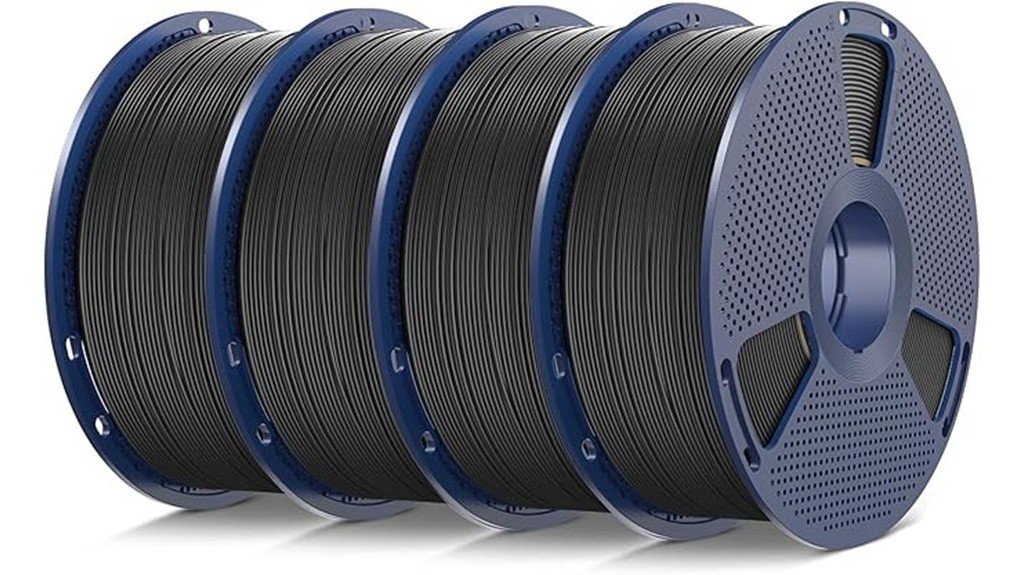
If you need filament that actually stands up to sun, rain, and heat, SUNLU’s 4kg ASA bundle is a smart pick — think of it as the outdoor-ready workhorse of your filament stash. You’ll get four 1kg spools of black ASA with tight dimensional accuracy (+/- 0.02mm), so parts fit and printers feed smoothly. It resists UV, rain, and heat, making it great for outdoor fixtures and functional mechanical pieces. Print at 230–260°C with a heated bed and consider an enclosure; use blue tape or glue stick to help adhesion. Reviews praise durability, though careful temperature control limits warping.
Best For: Outdoor-focused makers and engineers who need UV-, rain-, and heat-resistant filament for durable functional parts and fixtures.
Pros:
- Strong, tough ASA material with UV/rain/heat resistance ideal for outdoor applications.
- Tight dimensional accuracy (±0.02mm) and smooth feeding across four 1kg spools.
- Good layer adhesion and low clogging tendency when printed at recommended settings.
Cons:
- More tendency to warp than PLA; requires heated bed and preferably an enclosure for best results.
- Adhesion to build surface can be tricky—may need blue tape or glue stick.
- Higher printing temperatures (230–260°C) limit compatibility with some lower-end printers.
OVERTURE ASA 1.75mm 1kg 3D Printer Filament (White)
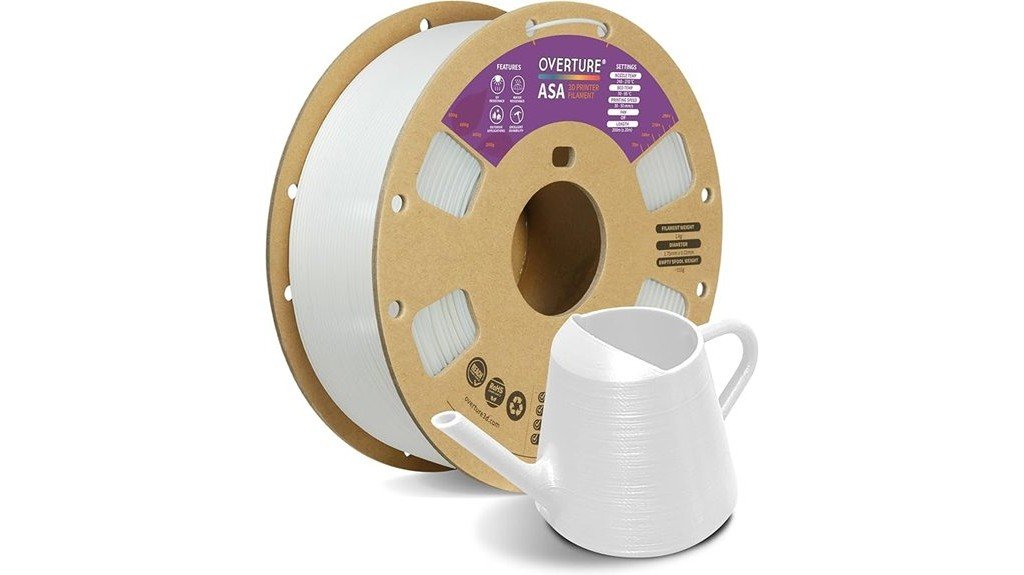
Outdoor makers who need durable, weatherproof parts will like OVERTURE’s ASA filament because it’s built to resist UV and temperature changes while still printing smoothly. You’ll appreciate its 1.75mm, 1kg spool in white, plus tight dimensional accuracy (+/- 0.02 mm) that keeps prints reliable. The ASA resists sun and heat, so your outdoor hinges or brackets last longer. Printing’s easy—users report clog-free, bubble-free results thanks to vacuum-sealed, dried spools and a patented formula. It works on most printers with standard settings, shows excellent layer adhesion, and comes with solid support and a 30-day return policy.
Best For: Outdoor makers and hobbyists who need durable, weatherproof 3D-printed parts (hinges, brackets, and functional components) that resist UV and temperature changes while printing reliably.
Pros:
- Excellent UV and heat resistance for long-lasting outdoor use.
- Tight dimensional accuracy (+/- 0.02 mm) and consistent, clog-free printing.
- Vacuum-sealed, dried spools and strong layer adhesion for reliable prints out of the box.
Cons:
- Typically more expensive than standard PLA or ABS filaments.
- May require higher nozzle/bed temperatures and enclosure for best results on some printers.
- Shorter shelf life (1 year unopened) if not stored properly.
Inslogic ASA 1.75mm UV & Weather Resistant 3D Printer Filament (1kg, White)
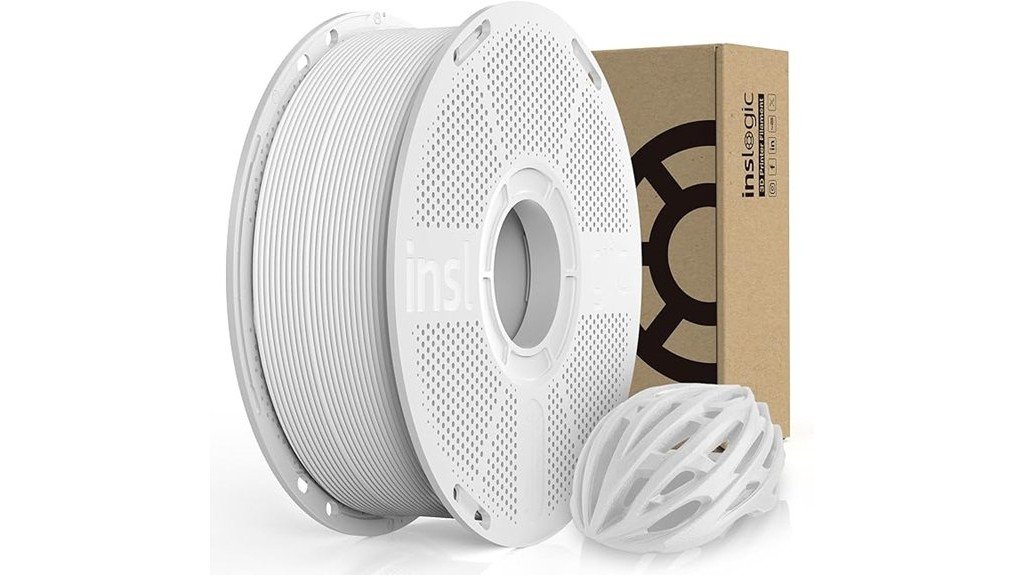
For anyone who needs tough, weather-ready prints, the Inslogic ASA 1.75mm filament is a solid choice because it’s specifically formulated to resist UV, rain, and heat while still printing cleanly. You’ll appreciate its low warping and fine detail on large parts, plus strong mechanical properties (52.4 MPa tensile, 18.33 KJ/m² impact) for functional outdoor pieces. It prints between 250–280°C, ships vacuum-sealed on a sturdy plastic spool, and works best in an enclosed printer for adhesion. Expect a learning curve with settings and a noticeable odor, but users report durable outdoor performance after over a month.
Best For: hobbyists and makers needing UV- and weather-resistant filament for durable outdoor or functional mechanical parts.
Pros:
- High outdoor durability with UV, rain, and heat resistance for long-lasting prints.
- Strong mechanical properties (52.4 MPa tensile, 18.33 KJ/m² impact) and low warping for large, precise parts.
- Vacuum-sealed packaging on a sturdy plastic spool for reliable moisture protection and feed.
Cons:
- Noticeable odor during printing; requires good ventilation.
- Requires an enclosed printer and tuning (temperature/bed settings) — some learning curve.
- Long-term outdoor aging vs. PETG not fully established beyond initial month-long tests.
Polymaker ASA 1.75mm Black 1kg 3D Printing Filament
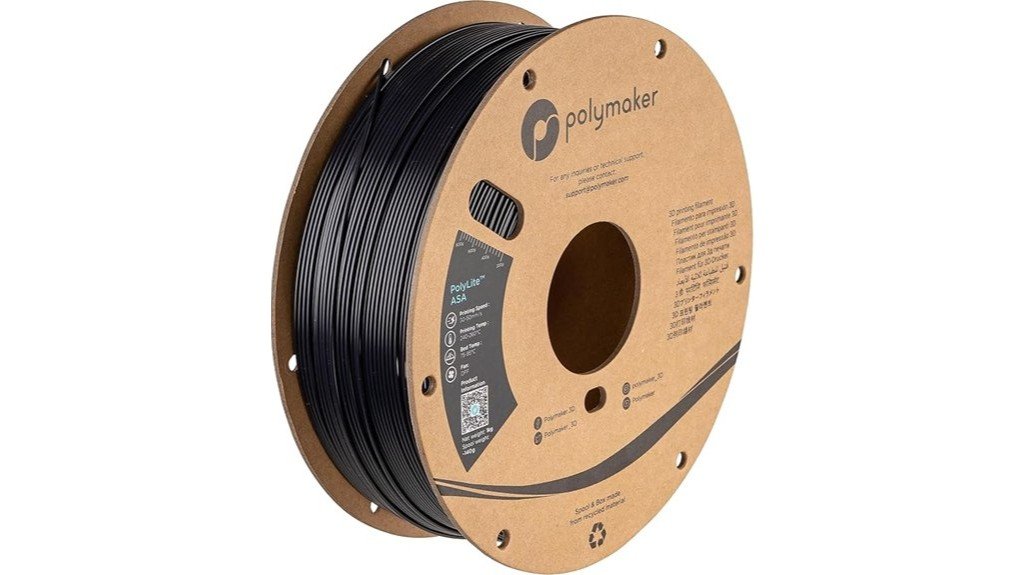
Polymaker’s ASA 1.75mm Black is a go-to choice when you need outdoor-ready prints that actually last, especially if you make functional parts like RC plane components or car accessories. You’ll get ABS-like strength with added UV and weather resistance, so parts handle sun, heat, and rough use better. Print with a 250°C nozzle and 90°C bed, around 50mm/s, and use an enclosed printer for larger pieces to avoid warping. It’s tough, resists environmental stress cracking, and withstands up to 100°C. Packaging uses recycled cardboard, and Polymaker offers lifetime technical support if you need help.
Best For: Makers and hobbyists who need durable, UV- and heat-resistant outdoor-ready parts (RC models, automotive accessories, and other functional prints) that benefit from ABS-like strength.
Pros:
- Excellent UV and weather resistance for long-lasting outdoor use.
- High toughness and heat resistance (up to 100°C), suitable for functional parts.
- Recycled cardboard packaging and lifetime technical support from Polymaker.
Cons:
- Requires high print temperatures (250°C nozzle, 90°C bed) and an enclosed printer for best results.
- More prone to warping than PLA, so large prints need careful setup.
- Less beginner-friendly compared with low-temperature, easy-to-print filaments.
iSANMATE ASA 1.75mm Black 1KG UV & Weather Resistant 3D Printer Filament
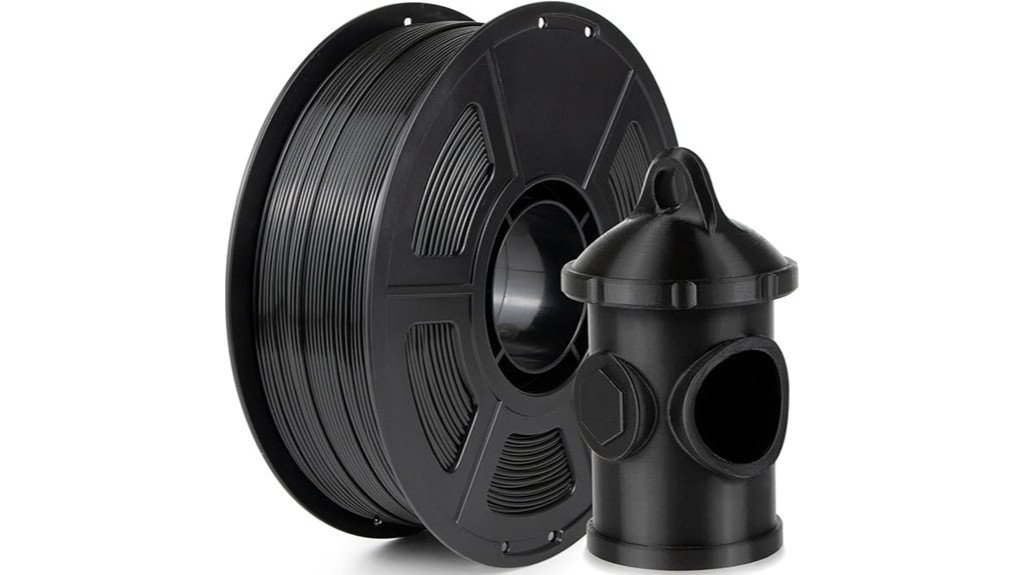
If you need a filament that’ll actually hold up on a porch, patio, or garden gadget, iSANMATE’s ASA is a smart pick—especially if UV resistance and low warping matter to you. You’ll get 1.75mm, 1kg of black ASA with tight +/-0.02mm accuracy, vacuum-sealed with desiccant. Print at 240–270°C with an 80–100°C bed, ideally in a closed printer; glue helps adhesion. Users praise durability and consistent prints for outdoor use, though some report clogging, odor, or adhesion failures if filament isn’t dry. It’s compatible with most printers, rated 4.4/5 from 428 reviews, and comes with a 30-day return option.
Best For: Outdoor-facing prints and functional parts for hobbyists or professionals who need UV- and weather-resistant 3D prints with low warping.
Pros:
- Exceptional UV and weather resistance, making it ideal for porch, patio, and garden applications.
- Tight dimensional accuracy (+/- 0.02mm) and reliable print quality when kept dry; vacuum-sealed with desiccant.
- Wide temperature compatibility (240–270°C nozzle, 80–100°C bed) and good speed range (30–100mm/s); compatible with most printers.
Cons:
- Can emit noticeable odor during printing and may require a closed enclosure or ventilation.
- Some users report clogging or adhesion failures, especially if filament is moist or bed prep is inadequate.
- Not the top-ranked filament overall and limited warranty details beyond a 30-day Amazon return.
Factors to Consider When Choosing Rated Filament for Outdoor Use
When you pick filament for outdoor use, you’ll want to check its UV resistance rating so sunlight won’t break your prints down over time. Also look for strong weather and moisture protection, a wide thermal stability range, and good mechanical strength so parts stay tough in changing conditions. Finally, make sure the material prints reliably and sticks well to your bed, because even the most durable filament won’t help if it warps or fails during printing.
UV Resistance Rating
Sunlight is one of the toughest tests for outdoor 3D prints, and you’ll want to pay close attention to a filament’s UV resistance rating before committing a project to the elements. A clear UV rating tells you how well a material resists breakdown from sunlight, which helps keep parts strong and colors from fading. Materials like ASA are known for holding mechanical properties and color over time, so they’re a safe bet. Look for filaments that’ve undergone UV testing and read customer feedback to see real-world performance — reviews often reveal issues tests miss. Choosing a high UV resistance rating lowers the chance of warping, cracking, or brittle failure, saving time and replacement costs.
Weather and Moisture Protection
Because outdoor prints face more than just rays from above, you’ll want filament that keeps water and weather from ruining your parts, and that starts with choosing materials labeled weather- or moisture-resistant. You should prioritize proven UV resistance too, since sunlight and moisture often work together to break down plastics. Pick filaments that explicitly state weather resistance so rain and humidity won’t infiltrate layers and cause delamination. Look for low-warp materials and low shrinkage rates; they keep parts dimensionally accurate when conditions change. Consider heat tolerance as part of the package so hot days don’t soften structural points. In my experience, choosing a filament with these combined traits saves headaches and replacement costs, keeping outdoor prints looking and performing their best over time.
Thermal Stability Range
Rain and heat protection are only part of the story — you also need to think about how hot or cold your filament can take before it changes shape or loses strength. Thermal stability range tells you the safe temperatures where a filament keeps its shape and properties, which matters when parts sit in sun or freezing nights. Look for filaments rated above about 100°C (212°F) if sunlight and hot surfaces are likely, since they resist warping. Your printer’s nozzle and bed temperatures give clues: filaments needing higher nozzle temps usually handle heat better, and correct bed temps help adhesion to avoid print warping. Don’t forget cold performance — some materials get brittle and fail in low temperatures, so choose accordingly.
Mechanical Strength Properties
When you’re picking a filament for outdoor parts, mechanical strength should be near the top of your checklist because it determines whether a piece will survive everyday stress, bumps, and sudden impacts. You want tensile strength that’s high—many quality outdoor filaments exceed 52.4 MPa—so parts don’t stretch or fail under load. Impact resistance, reported in KJ/m², tells you how well a print handles sudden hits without cracking. Low warping and shrinkage keep dimensions accurate so assemblies fit and stay strong. Layer adhesion matters too: good bonding prevents delamination when parts bend or take weight. Finally, choose materials that pair mechanical strength with UV resistance and heat stability so your outdoor prints last through seasons, not just weeks.
Printability and Adhesion
If you want outdoor prints that actually hold up, you’ll need to pay close attention to printability and bed adhesion—these two things decide whether your part comes out strong and with the right shape. Choose filaments with recommended nozzle temperatures around 230°C–280°C so layers fuse well; that range helps avoid under-extrusion or weak bonds. Use blue tape or a glue stick on the bed to prevent warping and lock the first layer in place. Print slower for tricky materials—30–100mm/s is a good window, and slower often means cleaner, stronger layers. Favor outdoor-rated filaments that report minimal clogging and bubble-free extrusion, and print inside an enclosure when you can to stabilize temperatures and further reduce warping for reliable results.
Long-Term Color Retention
Color matters more on outdoor prints than you might think, and getting prints that keep their color means choosing filaments made to resist sunlight, moisture, and temperature swings. You’ll want UV-stable materials because UV resistance is the biggest factor in preventing fading; filaments labeled for outdoor use usually score higher here. ASA, for example, holds color far better than standard PLA or ABS, so it’s a smart pick if your piece sits in the sun. Look for pigments and additives designed for colorfastness — they help maintain vibrancy after long exposure. Check manufacturers’ UV test data when available, and factor in humidity and temperature swings, since strong weather resistance supports long-term color integrity.
FAQ
Can ASA Filament Be Painted or Post-Processed for Color Matching?
1. Can ASA filament be painted?
Yes, ASA filament can be painted. It’s advisable to prepare the surface properly for the best results.
2. What is the first step in preparing ASA for painting?
The first step is to sand the surface of the ASA print to create a rough texture for better paint adhesion.
3. Should I use a primer before painting ASA?
Yes, using a plastic-compatible primer is recommended before applying paint to ensure better adhesion and a smoother finish.
4. What type of paint is suitable for ASA?
Acrylic or automotive paints are suitable choices for painting ASA. They adhere well and provide a durable finish.
5. Is it necessary to anneal ASA before painting?
While not strictly necessary, annealing ASA can improve its surface properties and enhance paint adhesion.
6. Can solvents be used on ASA to enhance paint application?
Yes, solvents can be used to smooth the surface of ASA, but they should be applied carefully to avoid damaging the print.
7. How can I ensure UV protection for painted ASA?
Using a UV-stable topcoat after painting will help protect the ASA print from sun damage and prolong the lifespan of the paint job.
8. What is the best way to achieve color matching with ASA?
To achieve color matching, select paints that closely match the desired color and apply them over a properly primed surface.
9. Are there specific brands of primer or paint recommended for ASA?
While there are many brands available, look for those specifically labeled as compatible with plastics for optimal results.
10. Can I achieve a glossy finish on painted ASA?
Yes, a glossy finish can be achieved by using a glossy topcoat after painting, which will enhance the overall appearance of the print.
11. How do I maintain the finish on painted ASA?
To maintain the finish, avoid harsh cleaning agents and consider applying a protective wax or sealant periodically.
How Long Do Outdoor ASA Prints Typically Last in Direct Sun?
FAQ 1: How long do unpigmented ASA prints last in direct sunlight?
Unpigmented ASA prints typically last between 2 to 5 years when exposed to direct sunlight.
FAQ 2: Can I extend the lifespan of unpigmented ASA prints?
Yes, using UV stabilizers, paints, or regular maintenance can help extend the lifespan of unpigmented ASA prints to 5 to 10 years or more.
FAQ 3: What factors affect the lifespan of ASA prints outdoors?
The main factors include the level of UV exposure, environmental conditions, and whether protective measures like UV stabilizers are applied.
FAQ 4: Do colored ASA prints last longer than unpigmented ones?
Colored ASA prints may have better UV resistance due to the pigments, but their lifespan can still vary based on the specific color and formulation.
FAQ 5: What are UV stabilizers?
UV stabilizers are additives used in materials to absorb or reflect harmful UV rays, helping to prevent degradation and extend the lifespan of prints.
FAQ 6: How often should I perform maintenance on ASA prints outdoors?
Regular maintenance, such as cleaning and applying protective coatings, can help maintain the appearance and strength of ASA prints. Frequency depends on environmental exposure but should be done at least once a year.
FAQ 7: What happens to ASA prints when they degrade?
As ASA prints degrade, they can lose mechanical strength, become brittle, fade in color, and develop surface cracks, affecting both appearance and functionality.
FAQ 8: Are there specific paints recommended for ASA prints exposed to sunlight?
Use paints specifically designed for outdoor use or those that contain UV protection to enhance the longevity of ASA prints in sunlight.
FAQ 9: Can I leave ASA prints outdoors all year round?
While ASA prints can withstand outdoor conditions, prolonged exposure to direct sunlight without protective measures can significantly shorten their lifespan.
FAQ 10: Is it worth investing in UV protection for ASA prints?
Yes, investing in UV protection, whether through stabilizers or coatings, can greatly enhance the longevity and appearance of ASA prints in outdoor settings.
Are Additives or Coatings Needed for Marine Saltwater Exposure?
FAQs on Additives and Coatings for Marine Saltwater Exposure
1. Why are additives necessary for saltwater environments?
Additives are essential because they enhance the material’s resistance to corrosion, UV damage, and biological growth. This protection is crucial for maintaining the integrity of materials exposed to harsh marine conditions.
2. What types of pigments are recommended for marine applications?
Corrosion-resistant pigments are recommended to provide a protective barrier against saltwater corrosion. They help maintain the appearance and durability of the materials over time.
3. How do UV stabilizers function in marine coatings?
UV stabilizers protect materials from the sun’s harmful rays, which can degrade surfaces over time. They ensure that colors remain vibrant and materials retain their strength in sunny marine conditions.
4. What role do hydrophobic sealants play in marine settings?
Hydrophobic sealants repel water, preventing moisture absorption that can lead to swelling and deterioration. This property is vital for maintaining the structural integrity of materials exposed to saltwater.
5. Are epoxy coatings effective for marine applications?
Yes, epoxy coatings are highly effective as they provide a strong, protective layer against corrosion and biofouling. They create a durable barrier that extends the lifespan of marine materials.
6. What is biofouling, and why is it a concern?
Biofouling refers to the accumulation of marine organisms on surfaces exposed to water. It can adversely affect the performance and longevity of materials, making protective coatings essential.
7. How does saltwater affect unprotected materials?
Unprotected materials are susceptible to corrosion, deterioration, and biological growth when exposed to saltwater. This exposure can significantly reduce their lifespan and overall performance.
8. Can additives improve the lifespan of marine structures?
Yes, using appropriate additives and coatings can significantly extend the lifespan of marine structures by providing necessary protection against environmental elements. This proactive approach can save costs on repairs and replacements.
9. Are there specific coatings recommended for different marine applications?
Yes, specific coatings may be recommended based on the application, such as boat hulls, piers, or marine equipment. It’s important to choose coatings tailored to the specific environmental challenges of each application.
10. How often should coatings be reapplied in marine environments?
The frequency of reapplication depends on exposure conditions and the type of coating used, but regular inspections are advised. Typically, coatings may need to be reapplied every few years to maintain optimal protection.
11. What factors should be considered when selecting coatings for marine use?
Key factors include the specific marine environment, the type of material being protected, and the expected wear and tear. Understanding these elements helps in selecting the most effective coatings and additives.
Can ASA Print Settings Differ Between Bowden and Direct-Drive Printers?
1. Do ASA print settings vary for Bowden and direct-drive printers?
Yes, ASA print settings differ between Bowden and direct-drive printers due to their unique mechanisms.
2. What retraction settings are needed for Bowden printers when printing with ASA?
Bowden printers require higher retraction settings to minimize stringing, as the longer filament path can lead to more oozing.
3. How does print speed for ASA differ between Bowden and direct-drive systems?
Bowden printers typically operate at slower speeds to reduce stringing, while direct-drive printers can print faster due to their more responsive filament handling.
4. What benefits do direct-drive printers offer when printing with ASA?
Direct-drive printers allow for lower retraction settings and finer tuning, which can result in cleaner prints with less stringing.
5. Can I use the same ASA settings for both printer types?
No, using the same settings for both printer types may lead to poor print quality, as each system has different requirements for optimal results.
6. What adjustments should I make for nozzle temperature when using ASA?
Nozzle temperature may remain similar, but you should monitor the output, as different printers might require slight adjustments based on their setup.
7. How does filament path affect ASA printing?
The filament path in a Bowden setup is longer and can cause delays in retraction, thus needing more careful tuning compared to the direct-drive setup.
8. Are there specific slicing software settings for ASA on these printers?
Yes, ensure that your slicing software allows for adjustments in retraction speed and distance, tailored to the type of printer you are using.
9. What is the impact of Bowden systems on layer adhesion with ASA?
Bowden systems may experience reduced layer adhesion if not properly calibrated, as the slower speeds and higher retraction can affect the bonding between layers.
10. Is fine-tuning necessary for both printer types when using ASA?
Absolutely, fine-tuning settings is essential for both printer types to achieve optimal print quality and minimize issues like warping and stringing.
Is ASA Safe for Food-Contact Outdoor Applications?
1. Is ASA safe for food-contact applications?
No, ASA is not inherently safe for food-contact applications unless certified by the manufacturer for food-grade compliance.
2. What risks are associated with using ASA for food-contact items?
Using ASA can lead to contamination from additives, surface porosity, and UV stabilizers that may leach into food.
3. Are there ASA filaments that are food-safe?
Only if specifically certified by the manufacturer can certain ASA filaments be deemed food-safe; always check for certification.
4. What should I consider when choosing materials for food-contact items?
Select materials that are explicitly labeled as food-grade and verify their compliance with safety standards.
5. Can I use ASA outdoors for food-related tasks?
Using ASA outdoors for food-related tasks is risky unless it is certified for food contact, due to potential contamination.
6. What alternatives are available for outdoor food-contact applications?
Consider using certified food-grade materials like PETG or PLA if you need to print items for outdoor food contact.
7. What does surface porosity in ASA mean for food safety?
Surface porosity can trap bacteria and contaminants, making ASA unsuitable for items that come into contact with food.
8. How can I ensure the materials I choose are safe?
Always look for third-party certifications and conduct tests if necessary to confirm the safety of materials for food contact.
9. Are there any guidelines for testing ASA safety for food contact?
Consult industry standards and guidelines for testing materials in food contact scenarios to ensure compliance and safety.
10. What happens if I use non-certified ASA for food contact?
Using non-certified ASA for food contact can lead to serious health risks due to contamination, which could be harmful if ingested.
Final Thoughts
When it comes to outdoor printing, you have robust options at your disposal: SUNLU, OVERTURE, Inslogic, Polymaker, and iSANMATE. Each of these brands offers filaments that stand up to UV exposure and harsh weather, all while maintaining impressive dimensional accuracy. Choose your filament based on factors like strength, available color variations, and the compatibility with your printer when it comes to ASA.
It’s imperative to conduct tests on your parts with different settings to find the optimal performance. Pay special attention to protecting threaded or thin components, as these are more susceptible to damage. For added durability, consider applying a UV-stable coating to enhance the longevity of your prints. With the right filament and some fine-tuning, your outdoor projects will not only remain functional but also maintain their aesthetic appeal for many years to come. Trust me, this is the way to ensure your outdoor prints thrive in any condition.